Executive Summary
In High-Frequency Trading, winning requires more than just raw speed. It demands execution determinism. Even a microsecond delay in how a processor responds to a market event can turn a profitable trade into a loss. One critical source of this timing variability is wake-up latency jitter (hereafter, "jitter"), which occurs when a CPU core briefly stalls while waking to process a signal. Jitter acts as a hidden tax on every trade by creating slippage that erodes the expected profitability of a strategy.
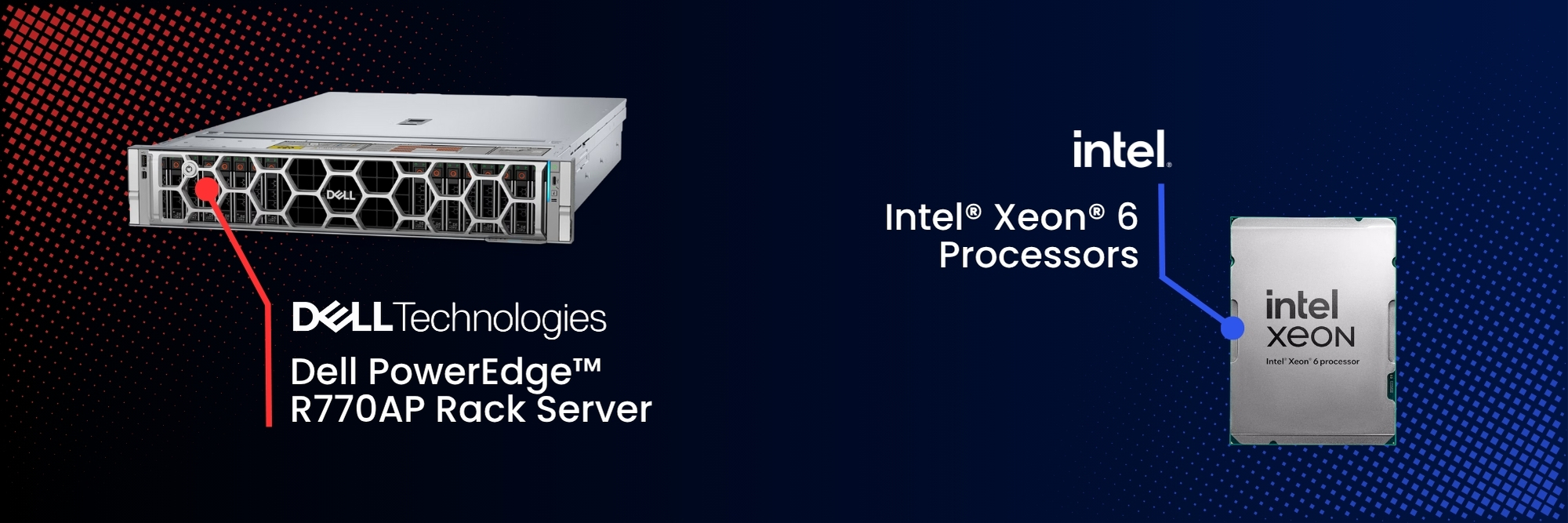
To quantify this execution-level tax, a measurement-driven evaluation framework was developed to bridge the gap between hardware behavior and financial outcomes. By using the profiling tool jitter-c to capture the timing consistency of the hardware and injecting those empirical measurements into the simulation engine based on the open source HFTbacktest[1] library, it is possible to evaluate the Dell PowerEdge R770AP with Intel Xeon 6th Gen 6980P processors (Granite Rapids) under simulated market conditions.
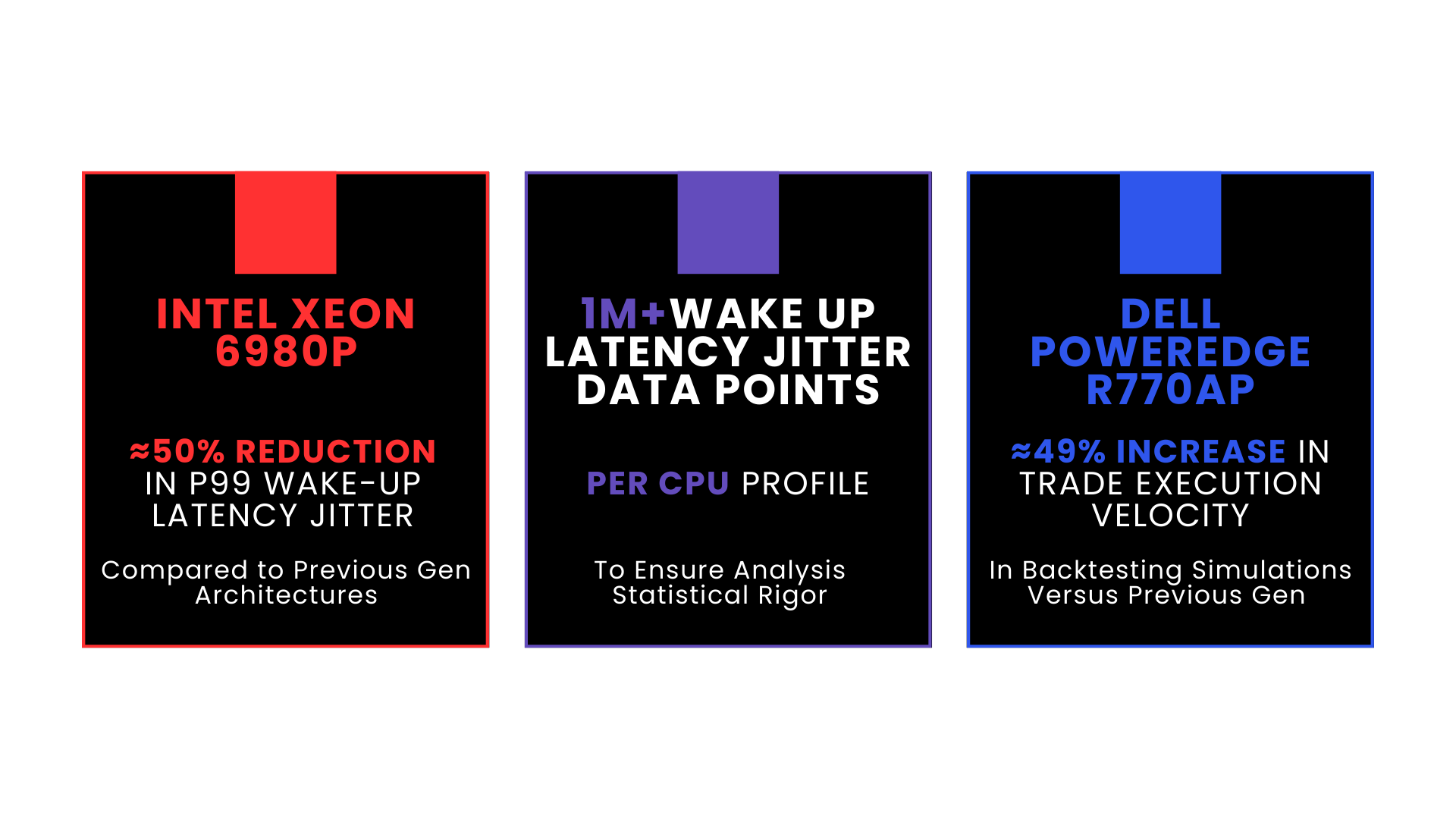
The results demonstrate measurable improvements across three technical dimensions:
- Deterministic Execution Stability: The Intel Xeon 6980P significantly reduces p99 wake-up jitter relative to previous generations, suppressing the tail latency spikes that break queue priority and trigger adverse selection. This tighter timing distribution ensures strategies hit their optimal pricing windows more consistently.
- Alpha Preservation through Noise Mitigation: Hardware does not create alpha; it preserves alpha by minimizing execution noise. By reducing hardware-induced micro stall variations (jitter), the Intel Xeon 6 architecture allows timing-sensitive strategies to realize more of their theoretical profit potential, leading to lower drawdown and higher realized returns.
- Scalable Parallelism without Timing Penalties: Conventional processors experience increased scheduling contention and timing jitter as core counts rise. Granite Rapids eliminates this limitation, delivering 128 cores per socket (256 total in dual-socket systems) while preserving sub-microsecond precision. Trading firms can scale parallel strategy execution without sacrificing timing accuracy. For firms seeking to protect trading logic from hardware-induced uncertainty, the Dell PowerEdge R770AP with Intel Xeon 6980P provides a high fidelity execution path. Its value is found in the realization of intent. It ensures that when a strategy identifies a profit opportunity, the hardware does not obstruct the result.
Introduction and Problem Statement
The Infrastructure ROI Challenge
High Frequency Trading (HFT) firms face a recurring decision: when should infrastructure be upgraded, and how can that investment be justified? Traditional CPU benchmarks like SPEC and CoreMark measure throughput and average latency, but these metrics fail to predict how hardware changes will affect trading performance. A processor that scores well on synthetic benchmarks may still introduce execution delays that erode strategy profitability.
The missing link is a methodology that connects hardware characteristics to financial outcomes. Without this, infrastructure teams rely on vendor specifications and theoretical projections rather than empirical evidence tied to actual trading behavior.
The Execution Determinism Gap
While network and disk latency jitter have traditionally received significant focus for optimization within HFT, the CPU itself remains an underexamined source of execution variance. The consistency with which a processor wakes, processes market signals, and submits orders directly determines whether a strategy captures its intended edge or loses it to slippage. While raw speed sets the baseline, timing variability determines whether trades capture alpha or suffer from adverse selection.
This variability, known as wake-up latency jitter, manifests as unpredictable micro-stalls caused by OS scheduler overhead, CPU power state transitions, and cache coherency protocols. Standard benchmarks mask these outliers by reporting averages. For an HFT firm, a 50-microsecond variation that appears negligible in a benchmark score could be financially material in production.
A Platform for Hardware to Backtesting Simulations
This technical brief introduces a jitter-aware backtesting platform developed by Metrum AI that addresses this gap. The platform captures empirical CPU timing characteristics using jitter-c, a purpose-built profiling tool that collects over 1,000,000 wake-up latency samples per processor. These measured jitter profiles are then integrated into strategy simulations, introducing empirically-derived timing variability that reflects the actual behavior of each hardware configuration under test.
The result is a methodology that translates hardware specifications into trading performance metrics: Sharpe ratio, return on investment, drawdown, and execution volume. This brief presents findings from applying the platform to compare the Intel Xeon Platinum 8592+ (5th Gen, 128 total cores) on the Dell PowerEdge R760 with the Intel Xeon 6980P (6th Gen, 256 total cores) on the Dell PowerEdge R770AP.
Background: Why Execution Determinism Matters
For latency-sensitive trading systems, mean performance tells only part of the story. Timing variance can be equally important as absolute latency. When a trading thread sleeps waiting for a timer or market event, the actual wake-up time varies based on OS scheduler overhead, CPU power state transitions, cache coherency protocols, and cross-core coordination.
This variance directly affects order execution timing. A thread that wakes later than expected may find that market conditions have changed: prices have moved, queue positions have degraded, or trading opportunities have expired. Traditional performance benchmarks (SPEC, CoreMark) focus on throughput and mean latency but do not capture the tail behavior that affects real-time trading systems.
This gap creates a fundamental problem for infrastructure planning. Trading firms cannot predict how a CPU, server, and system settings will affect strategy performance because the metrics that matter (worst-case timing variability at the p99 and p99.9 levels) are not captured by standard evaluation tools. The jitter-aware backtesting platform addresses this by measuring the timing characteristics that actually drive execution quality, then modeling their impact on strategy behavior under realistic market conditions. This enables HFT firms to make data-driven decisions about hardware selection and strategy deployment.
Solution Workflow and Architecture
To test the impact of wake-up jitter on trading outcomes, a specialized solution architecture and simulation workflow were developed. This framework translates physical hardware measurements into financial performance metrics. By capturing real world timing profiles and injecting them into high-fidelity strategy simulations, it is possible to quantify how specific infrastructure choices impact execution quality. This methodology ensures that server upgrades are evaluated based on their actual contribution to strategy success. The architecture flows through three integrated stages: hardware profiling, simulation preparation, and execution analysis.
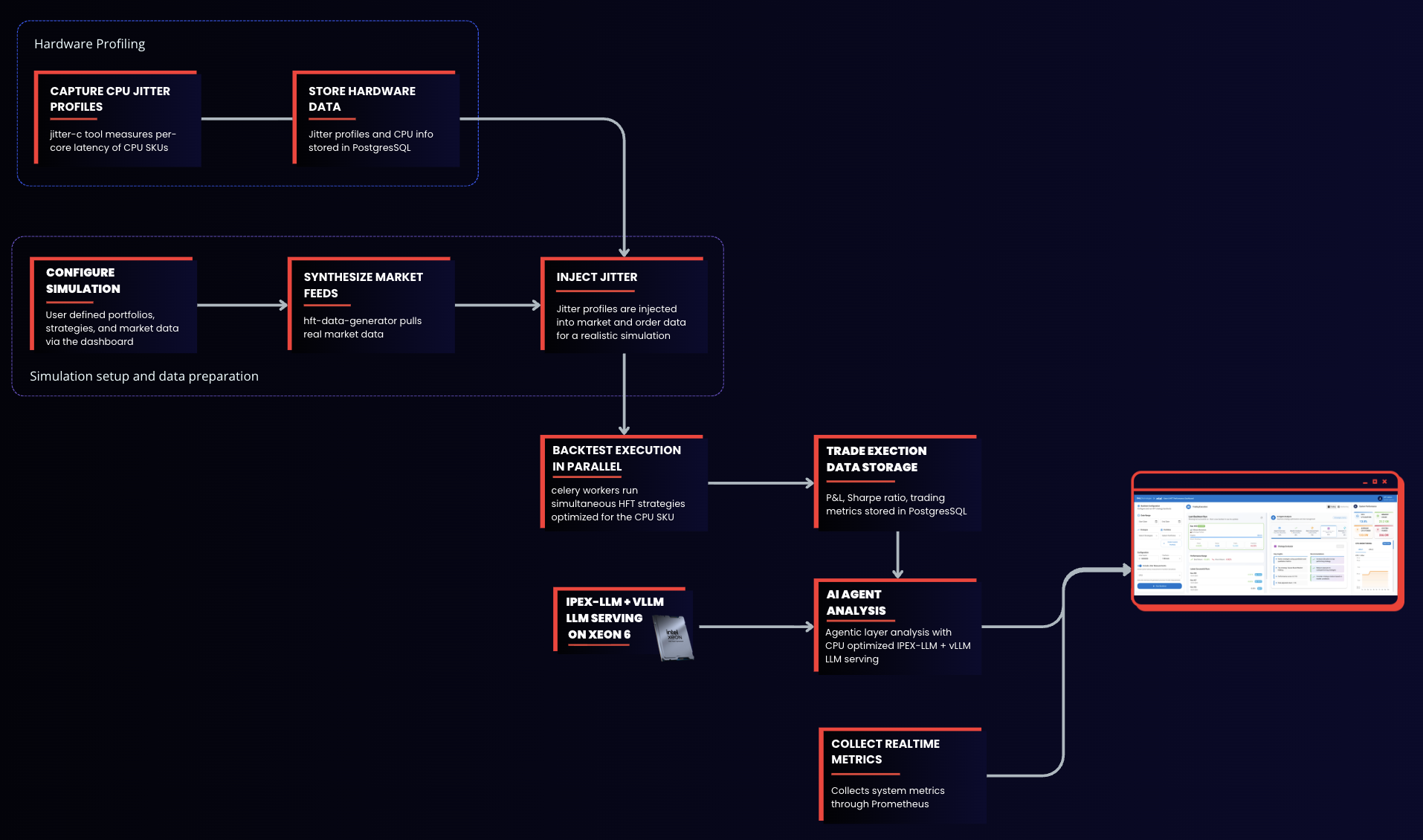
Figure 1. Solution Workflow
Stage 1: Hardware Profiling
The process begins with empirical measurement of CPU timing characteristics. The jitter-c tool captures per-core wake-up latency jitter profiles across target CPU SKUs, collecting over 1,000,000 samples per processor under performance-optimized conditions. These jitter profiles and associated CPU metadata are stored in a relational database (PostgreSQL), creating a persistent hardware fingerprint database that enables reproducible comparisons across processor generations. This empirical grounding ensures hardware performance is quantified rather than assumed, eliminating reliance on synthetic benchmarks.
Stage 2: Simulation Setup and Data Preparation
Users configure backtests through a dashboard interface, defining portfolios, trading strategies, and market data parameters. The Market Data Generator synthesizes realistic market feeds by pulling historical market data, ensuring simulations reflect actual market microstructure. The measured jitter profiles are then injected into this market and order data, introducing realistic execution timing variability specific to each CPU SKU being evaluated. Because jitter profiles are stored persistently, teams can reproduce comparisons across time and configurations with a consistent methodology.
Stage 3: Backtest Execution and Analysis
"Celery" (a Python based task execution library) workers execute HFT strategy simulations in parallel, with each backtest incorporating the CPU-specific jitter characteristics. The 256 core Intel Xeon 6980P Dell PowerEdge R770AP configuration enables high-throughput parallel execution, allowing multiple strategies and configurations to be evaluated simultaneously. Trade execution data - including P&L, Sharpe ratio, and trading metrics - is stored in PostgreSQL for analysis. An AI agent layer, powered by IPEX-LLM and vLLM serving optimized for Xeon 6, synthesizes results into structured assessments covering market regime analysis, risk evaluation, and strategy ranking. Prometheus collects real-time system metrics throughout execution, enabling performance monitoring and infrastructure optimization. The result is a decision support pipeline that transforms raw metrics into actionable infrastructure recommendations.
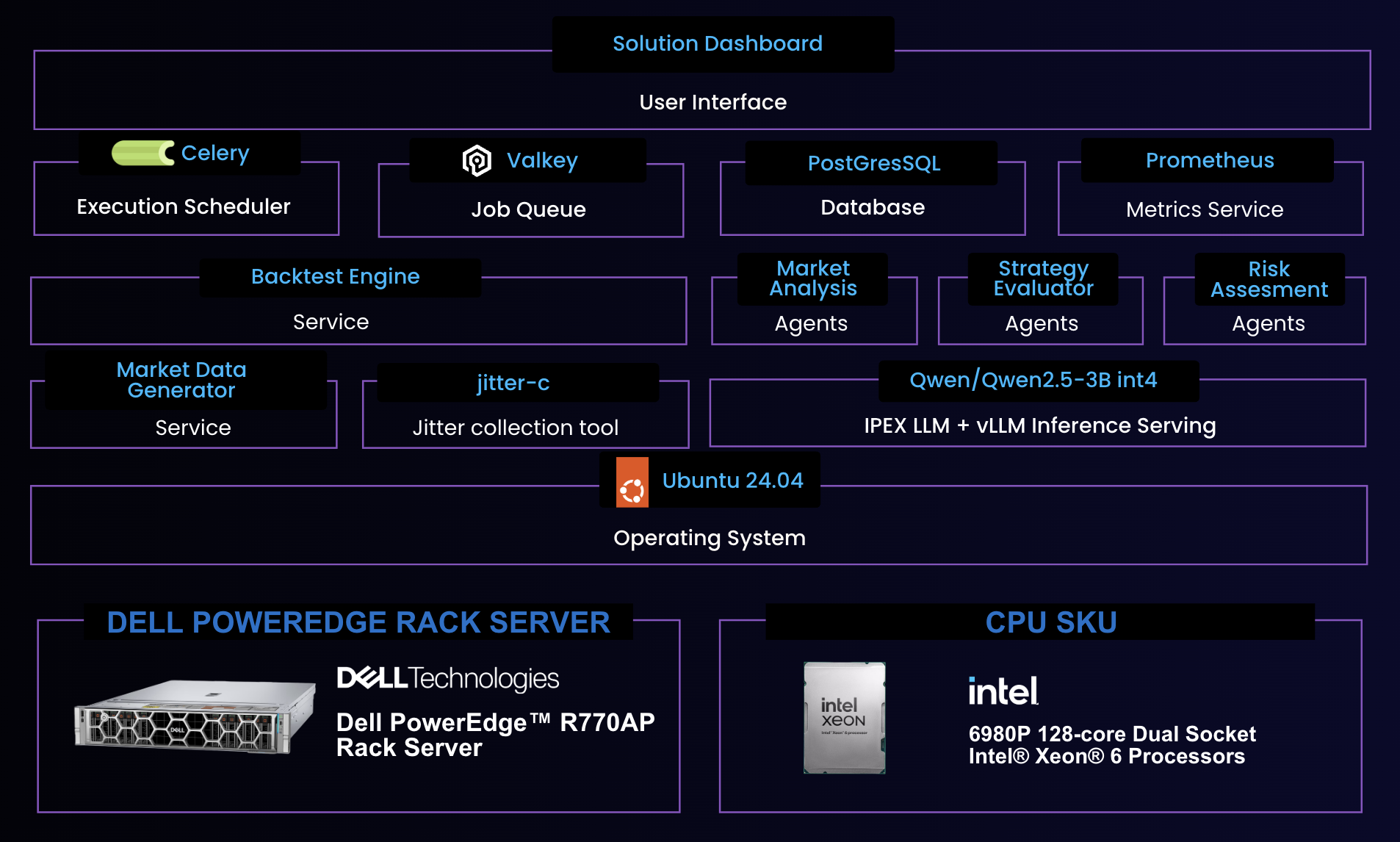
Figure 2. Solution Architecture Dashboard
Solution Dashboard
The software stack is deployed on the Dell PowerEdge R770AP with dual-socket Intel Xeon 6980P processors (256 cores total) running Ubuntu 24.04. The architecture includes the following components:
- jitter-c, a purpose-built profiling tool that measures per-core wake-up latency jitter, collecting over 1,000,000 samples per processor to create empirical timing fingerprints for each CPU SKU.
- Backtest Engine, the core simulation service that executes HFT strategies while incorporating CPU-specific jitter profiles into order timing and execution modeling.
- Market Data Generator, a service that synthesizes realistic tick-level market feeds from historical sources, ensuring simulations reflect authentic market microstructure.
- Qwen/Qwen2.5-3B int4, a quantized large language model served through IPEX-LLM and vLLM, leveraging Intel Xeon 6 optimizations for efficient CPU-based inference powering the AI analysis agents.
- Celery and Valkey, distributed execution scheduler and job queue that orchestrate parallel backtest jobs across available compute resources.
- PostgreSQL, persistent storage for jitter profiles, hardware metadata, backtest configurations, and trade execution results including P&L, Sharpe ratios, and performance metrics.
- Prometheus, real-time metrics collection service enabling infrastructure monitoring and performance validation throughout execution.
- Solution Dashboard, the primary user interface where trading teams configure portfolios, select strategies, and define market data parameters for backtesting.
- AI Analysis Agents (Market Analysis, Strategy Evaluator, Risk Assessment), three specialized agents that transform raw backtest output into actionable intelligence covering market regime identification, strategy ranking, and risk quantification.
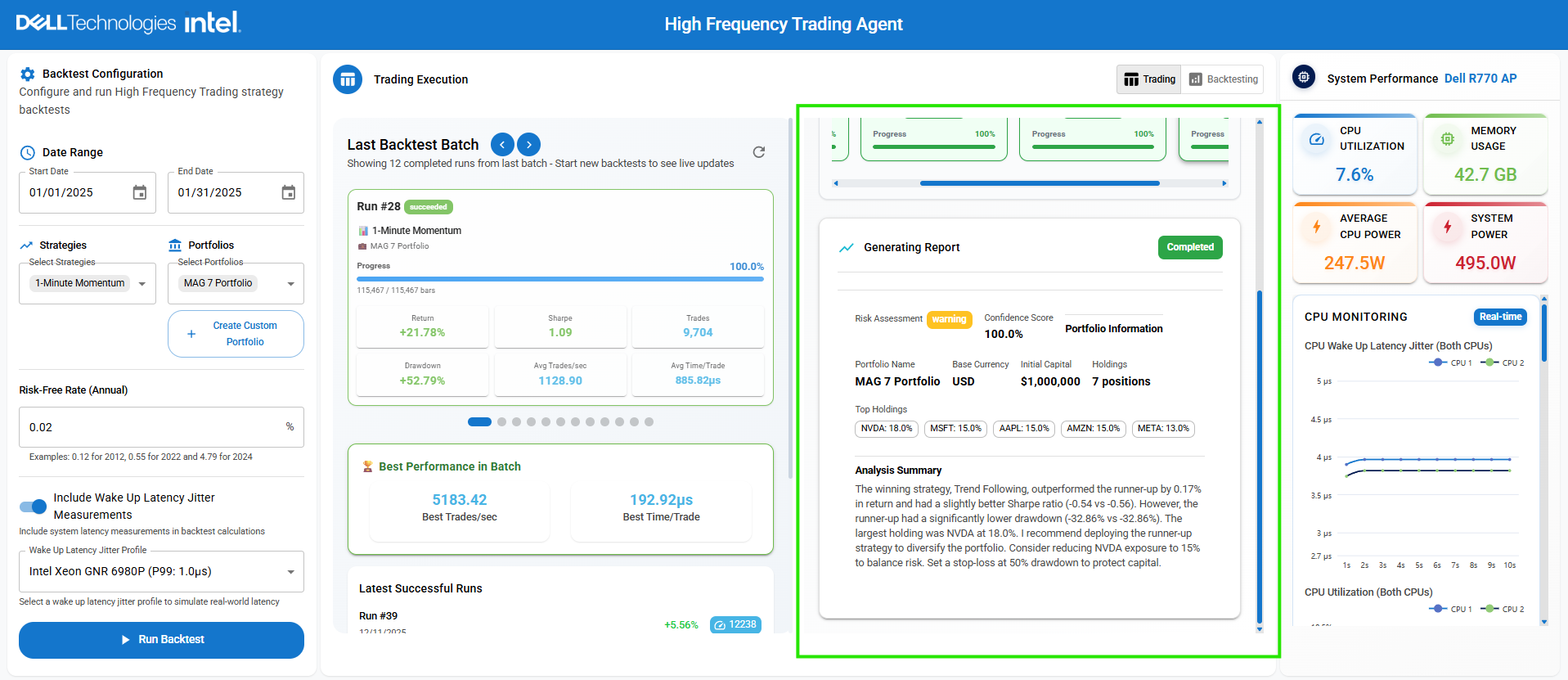
Figure 3. User Interface Dashboard
The platform interface guides users from configuration through analysis in a single unified view. On the left, users define their simulation parameters: date range, portfolio selection (either custom or from existing templates like the MAG 7 Portfolio), risk-free rate, and the wake-up latency jitter profile for the CPU under evaluation. This last setting is what enables direct comparison of strategy performance across different processor architectures by selecting from measured jitter profiles stored in the platform database.
The center panel displays backtest execution and results as they complete, surfacing key metrics including return on investment, Sharpe ratio, trade count, drawdown, average trades per second, and time per trade. Users can review batch runs, compare strategies, and identify top performers without navigating away from the main view.
Once backtests complete, the AI agent panel generates automated analysis powered by Qwen2.5-3B (int4 quantized) running on Intel's IPEX-LLM. The agent evaluates portfolio allocation, analyzes performance across multiple strategies and portfolio configurations, and provides recommendations tailored to user risk tolerance. By correlating strategy sensitivity with CPU jitter characteristics, the agent helps users identify which combinations of portfolio exposure and processor architecture maximize risk-adjusted returns. The output includes confidence scores, concentration risk warnings, position adjustment suggestions, and plain-language summaries that translate raw metrics into actionable deployment guidance.
The right panel provides real-time system monitoring of the Dell PowerEdge R770AP server running the solution. CPU utilization, memory usage, power draw, and live wake-up latency jitter are displayed continuously, ensuring users can verify that backtest results reflect true strategy behavior rather than environmental noise or resource contention on the host system.
Hardware Configuration Summary
The solution and backtesting were performed on the Dell PowerEdge R770AP Server and the Dell PowerEdge R760 Server to showcase generation-over-generation performance improvements in wake-up latency jitter.
| Server Platform | Dell PowerEdge R770AP Server | Dell PowerEdge R760 Server |
|---|---|---|
| CPU SKU | Intel Xeon 6980P Processor | Intel Xeon Platinum 8592+ Processor |
| Sockets | 2 | 2 |
| Cores | 256 (128 per socket) | 128 (64 per socket) |
| Threads per Core | 1 | 1 |
| CPU Cache | L1: 28 MiBL2: 512 MiBL3: 1008 MiB(504MiBx2) | L1: 10 MiBL2: 256 MiBL3: 640 MiB (320MiB x 2) |
| Memory Footprint | 2304 GB (24x96GB) DDR5-6400 | 2048 GB (16x128GB) DDR5-5600 |
| BIOS | Dell Inc, Version 1.1.5, | Dell Inc, Version 2.2.7 |
| Storage | ~39 TB | ~21 TB |
| OS | Ubuntu 24.04.3 LTS, Kernel 6.8.0-90-generic | Ubuntu 24.04.3 LTS, Kernel6.8.0-87-generic |
Figure 4. Hardware configuration across systems
Methodology
Using the Dell PowerEdge R770AP with Intel Xeon 6980P and the Dell PowerEdge R760 with Intel Xeon 8592+ configurations described above, the jitter-aware backtesting platform was deployed to measure and compare execution characteristics. The platform combines two core capabilities: empirical hardware profiling and realistic strategy simulation. This section describes how each component works and how they integrate to translate CPU characteristics into trading performance metrics.
Hardware Profiling with jitter-c
The platform captures CPU timing characteristics using jitter-c, a purpose-built profiling tool developed by Metrum AI. Wake-up latency jitter refers specifically to the variability in how long it takes for a thread scheduled to wake at a precise time to actually begin executing on a CPU core. This metric isolates scheduling variability introduced by CPU architecture, deliberately excluding factors like network delays, interrupts, memory behavior, and application logic. Wake-up latency jitter is particularly well-suited for cross-architecture comparison because it can be cleanly isolated, exhibits meaningful variation across CPU generations, and directly affects timing-critical operations in high frequency trading environments.
jitter-c operates by pinning one measurement thread to each selected CPU core and scheduling periodic wake deadlines at fixed intervals using a monotonic clock. For each wake cycle, it measures the difference (in nanoseconds) between the scheduled wake deadline and actual execution time. The tool collects over 1,000,000 samples per processor, then characterizes the resulting distribution using min, max, mean, standard deviation, and high-percentile statistics (p50, p90, p99, p99.9). It also produces histogram representations that expose long-tail stalls that averages do not capture.
The measurement is structured per core to enable topology-aware comparisons across the processor, supporting identification of cores with tighter distributions for pinning latency-critical threads. Results are emitted in JSON format and stored in PostgreSQL, creating a persistent hardware fingerprint database that enables reproducible comparisons across processor generations.
Jitter Measurement Results
Each processor was profiled using jitter-c with over 1,000,000 wake-up latency jitter samples collected under performance-optimized conditions:
| Processor | Generation | p99 Jitter | Tail Behavior | Distribution |
|---|---|---|---|---|
| Intel Xeon 6980P | Gen 6 | ~1.0 us | Rare (≤1–2 ms) | Tight, controlled |
| Intel Xeon 8592+ | Gen 5 | ~2.0-5.0 us | Outliers to 100-500 us | Broad, long tail |
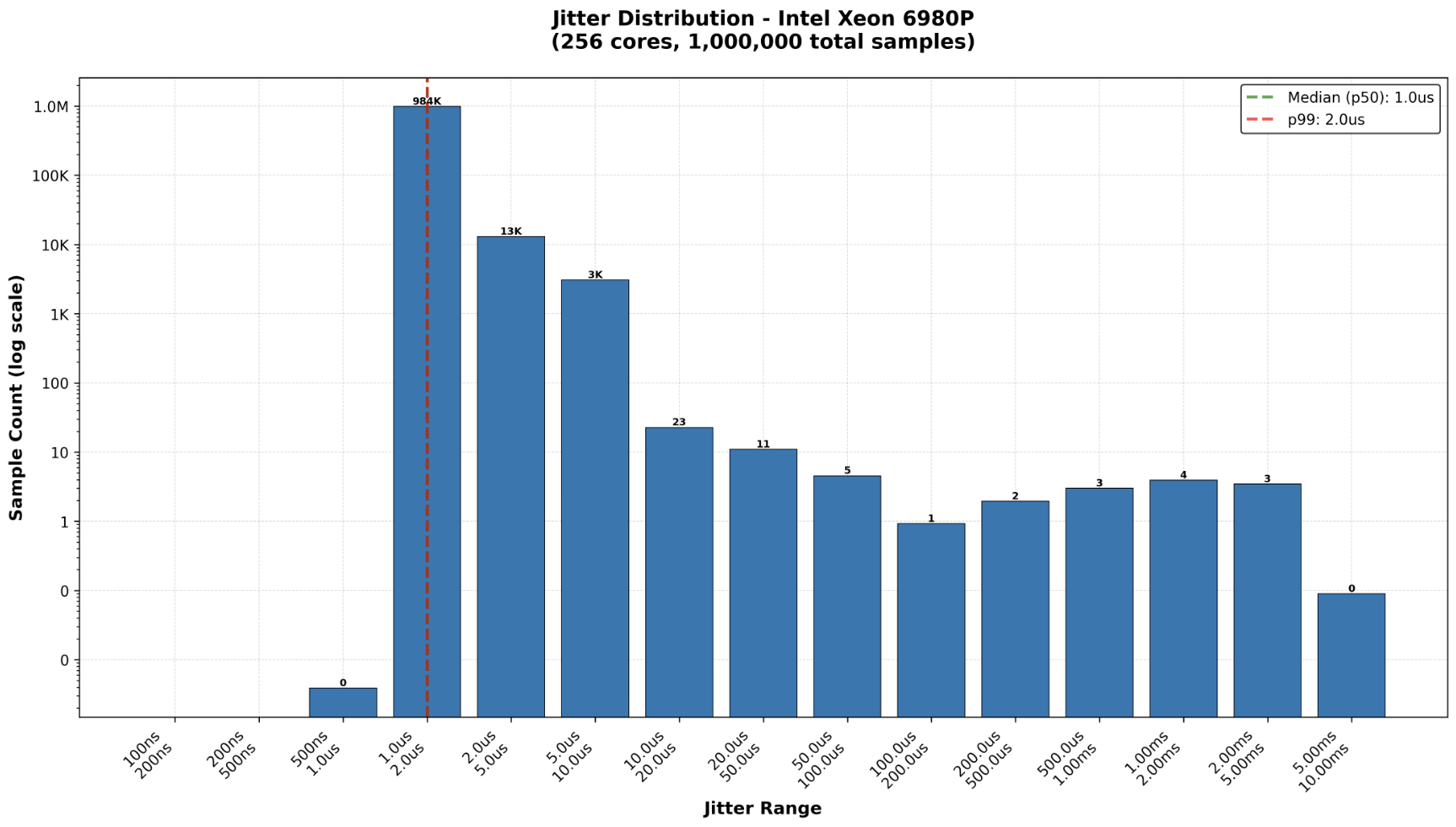
Figure 5. Jitter distribution for Intel Xeon 6980P (6th Gen) on Dell PowerEdge R770AP. Median 1.0 us, p99 1.0 us, with 99%+ of samples in the 1-2 us range.
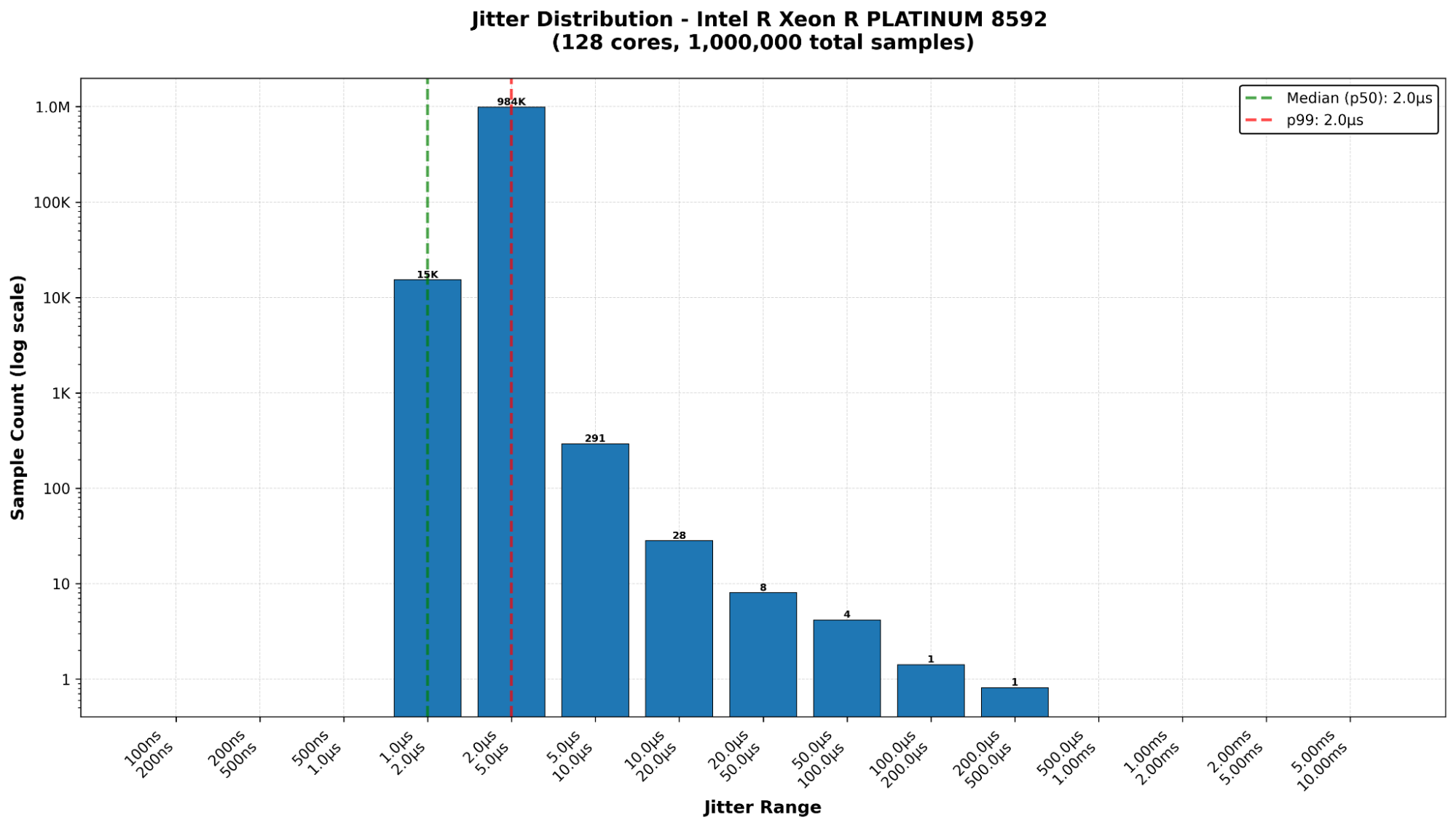
Figure 6. Jitter distribution for Intel Xeon Platinum 8592+ (5th Gen) on Dell PowerEdge R760. Median 2.0 us, p99 2.0 us, with broader baseline and tail events extending to hundreds of microseconds.
Jitter-Aware Backtesting Framework
To translate hardware measurements into financial performance, the platform integrates jitter profiles directly into the HFTbacktest simulation engine. Rather than modeling execution latency as an ideal constant, the framework samples from empirically measured jitter distributions to model latency as a stochastic variable.
During simulation, every strategy wake-up event samples a specific delay from the appropriate CPU's jitter profile. This injected delay directly impacts signal evaluation timing, order submission, and queue interaction. The same strategy can be evaluated against multiple CPU profiles (Intel Xeon 6980P vs. Intel Xeon 8592+) under identical market conditions, isolating how architectural differences drive changes in Sharpe ratio, returns, and fill rates.
The simulation outputs include P&L, Sharpe ratio, drawdown, and trade execution volume, which are stored in PostgreSQL for analysis. This enables direct comparison of strategy performance across CPU configurations, quantifying the financial impact of hardware choices.
Assumptions, Scope, and Limitations
This methodology relies on specific assumptions and simplifications to isolate the impact of CPU microarchitecture:
- Latency Proxy: CPU wake-up jitter is used as a proxy for execution delay, assuming a proportional relationship where scheduling jitter is a dominant component of overall latency.
- Slippage Modeling: The engine uses a simplified linear model where latency directly correlates with slippage (approximately 0.05 basis points per microsecond), representing queue position degradation.
- Distribution Fitting: The simulation utilizes a lognormal distribution fitted to the measured p99 and maximum latency values to approximate the right-skewed nature of tail latency.
- Scope: The analysis measures correlation, not causation. It does not control for every confounding variable (such as thermal throttling or background OS tasks) nor does it validate results against live production trading P&L.
Key Takeaways from Simulated Backtesting
The platform is designed to provide directional guidance for infrastructure decisions, not precise P&L projections. The methodology demonstrates that CPU architecture choices have a measurable impact on strategy behavior, enabling firms to make evidence-based hardware selection decisions.
With the methodology established, the following sections present the results of applying this framework to compare the Intel Xeon 6980P against the Intel Xeon 8592+. Three findings emerged from the simulated backtesting, each demonstrating a distinct dimension of performance improvement.
1. Tighter Jitter = Better Execution Stability
The 6th Gen Xeon (Granite Rapids) architecture cuts wake-up jitter roughly in half versus the 5th Gen (Emerald Rapids), effectively eliminating the tail jitter spikes that cause slippage during the critical execution window. This precise execution stability ensures trades hit their optimal pricing windows, directly driving Sharpe ratio improvements of +7.1% (5 Min Mean Reversion) and +31.5% (Market Making Spread with Adaptive Price Thresholds) in the January 2025 Magnificent Seven portfolio analysis.
Technical detail: The Intel Xeon 6980P maintains p99 wake-up latency jitter at approximately 1 us, with over 99% of samples concentrated in the 1-2 us range. The Intel Xeon 8592+ exhibits a broader baseline distribution (2-5 us) with meaningful tail events extending into the hundreds of microseconds. These tail events, although rare, disproportionately break queue priority, trigger adverse selection, and amplify loss clustering in HFT strategies.
The distribution graphs below display total simulated execution time per trade, which incorporates the measured jitter profile. Absolute execution times vary by strategy type (microseconds for market making spread, milliseconds for mean reversion) while the relative impact of jitter reduction remains consistent across both.
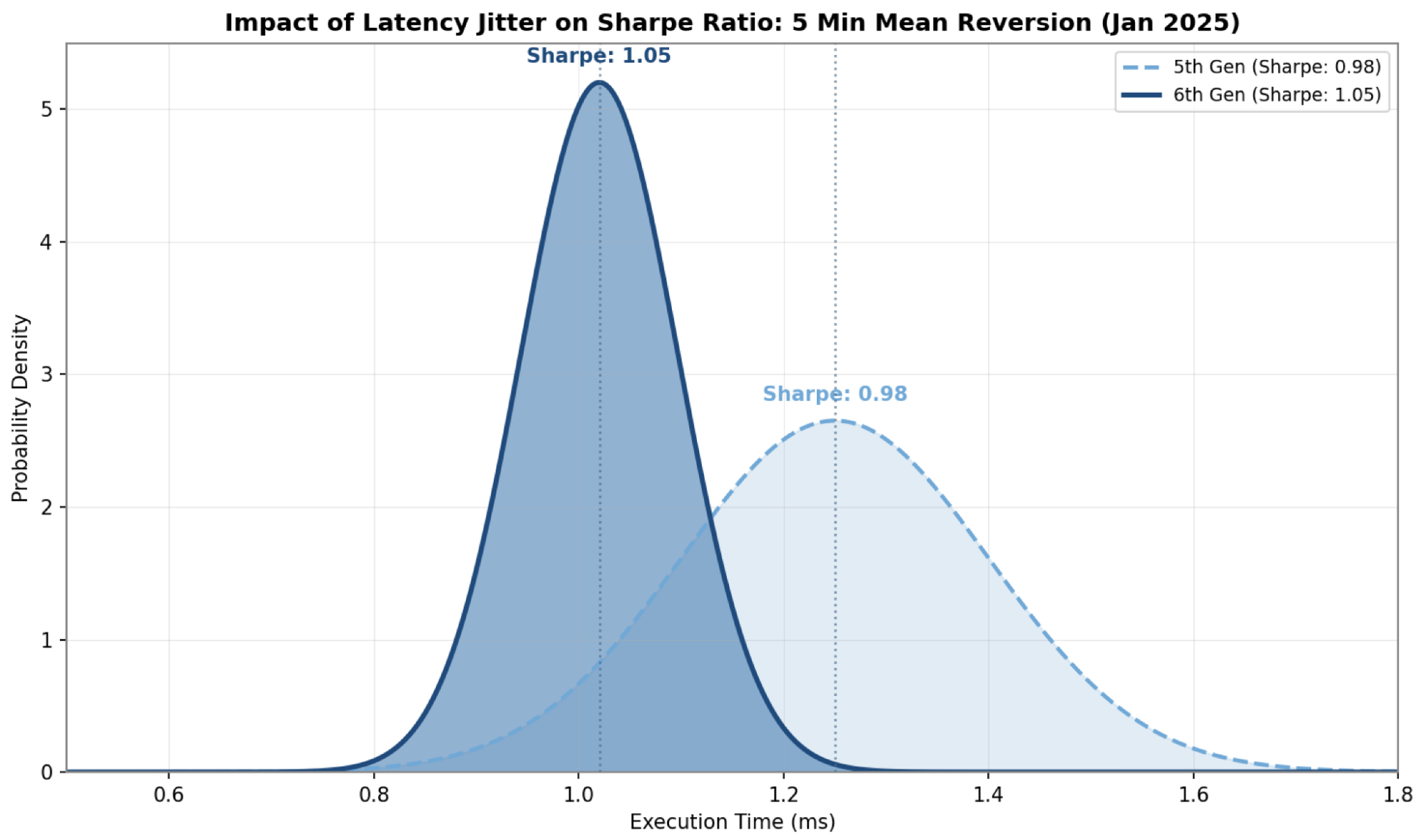
Figure 7. Impact of latency jitter on Sharpe ratio for the 5-Minute Mean Reversion strategy. The 6th Gen's tighter distribution (1.02ms peak) delivers a 7.1% Sharpe improvement over the 5th Gen (1.25ms peak).
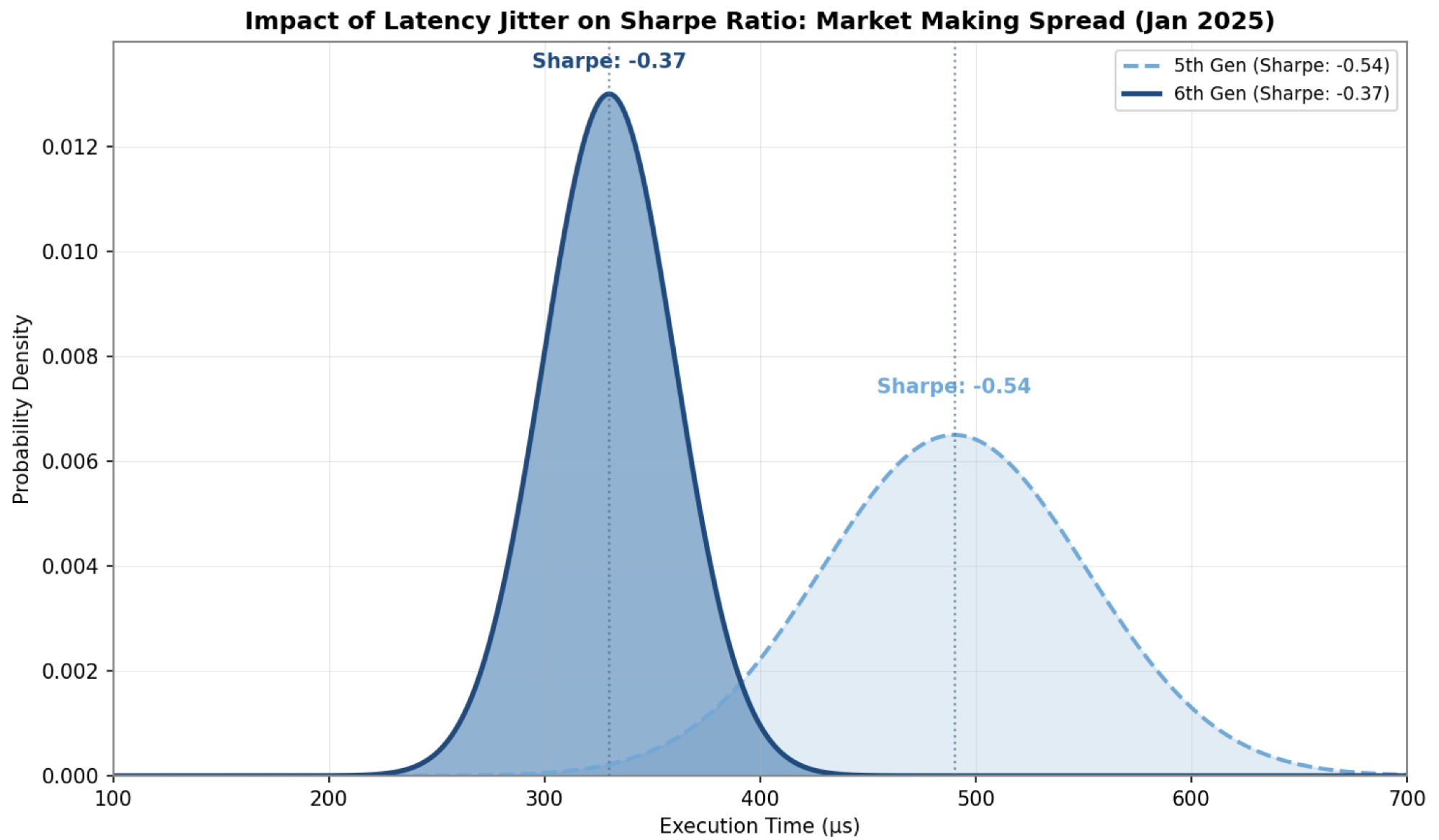
Figure 8. Impact of latency jitter on Sharpe ratio for the Market Making Spread strategy. The 6th Gen's compressed distribution (330 us peak) delivers a 31.5% Sharpe improvement over the 5th Gen (490 us peak).
2. Simulated Alpha Preservation through Jitter Reduction
Jitter-aware backtesting allows firms to move beyond theoretical benchmarks and quantify how hardware choice impacts execution fidelity. These simulations illustrate that hardware does not create alpha but instead preserves it by minimizing execution noise. By reducing the frequency and magnitude of hardware-induced micro stalls, the Xeon 6 architecture allows timing-sensitive strategies to realize more of their theoretical profit potential.
In these specific simulated backtesting scenarios, the reduction in execution noise allowed the strategies to realize the following performance deltas:
- 24.3% higher simulated return for the tested Mean Reversion strategy (Figure 9).
- 36.1% reduction in simulated drawdown losses (Figure 9).
- 49.3% increase in trade execution volume for the Market Making Spread strategy (Figure 11).
Tighter jitter distributions improve both upside capture and downside protection. This methodology enables firms to evaluate hardware upgrades using the same economic criteria applied to trading capital deployment.
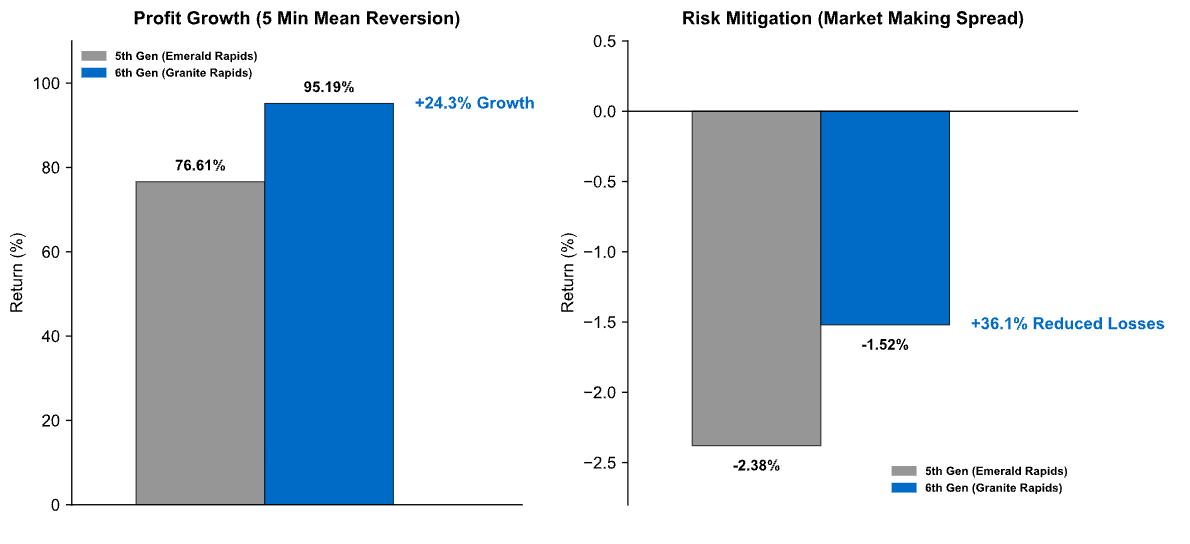
Figure 9. Simulated Financial impact comparison across simulated strategies. The left panel shows return on investment for 5-Minute Mean Reversion, where the 6th Gen achieves 95.19% versus 76.61% for the 5th Gen (+24.3%). The right panel shows drawdown for Market Making Spread, where the 6th Gen reduces maximum drawdown from -2.38% to -1.52% (36.1% improvement). These backtests were conducted for the month of January in 2025. Together, these results demonstrate that tighter jitter distributions improve both upside capture and downside protection. Results are simulations & are not indicative of future results.
3. Scalable Parallelism without Sacrificing Determinism
Traditionally, doubling core counts increases scheduling contention and worsens jitter. The Granite Rapids architecture breaks this trade-off by delivering 256 cores while simultaneously tightening timing distributions. As shown in Figures 5 and 6, the Intel Xeon 6980P maintains p99 jitter at approximately 1 us despite doubling core density. The timing penalty that typically accompanies increased parallelism does not materialize. This enables firms to increase parallel strategy density without sacrificing the execution precision of individual threads.
The technical analysis of the Intel Xeon 6980P highlights several architectural innovations:
- Double the cores for greater parallel strategy execution.
- ~50% lower p99 jitter for tighter execution determinism.
- ~57% larger L3 cache to reduce cache-miss-induced latency.
- Refined scheduler algorithms to minimize state transition jitter.
The impact of this scalability is visible in the trade throughput data in Figures 10 and 11. The 6th Gen Xeon increased trade velocity by 21.1% for Mean Reversion and 48.6% for the Market Making Spread. This represents a significant advancement for firms requiring both high computational throughput and extreme execution precision.
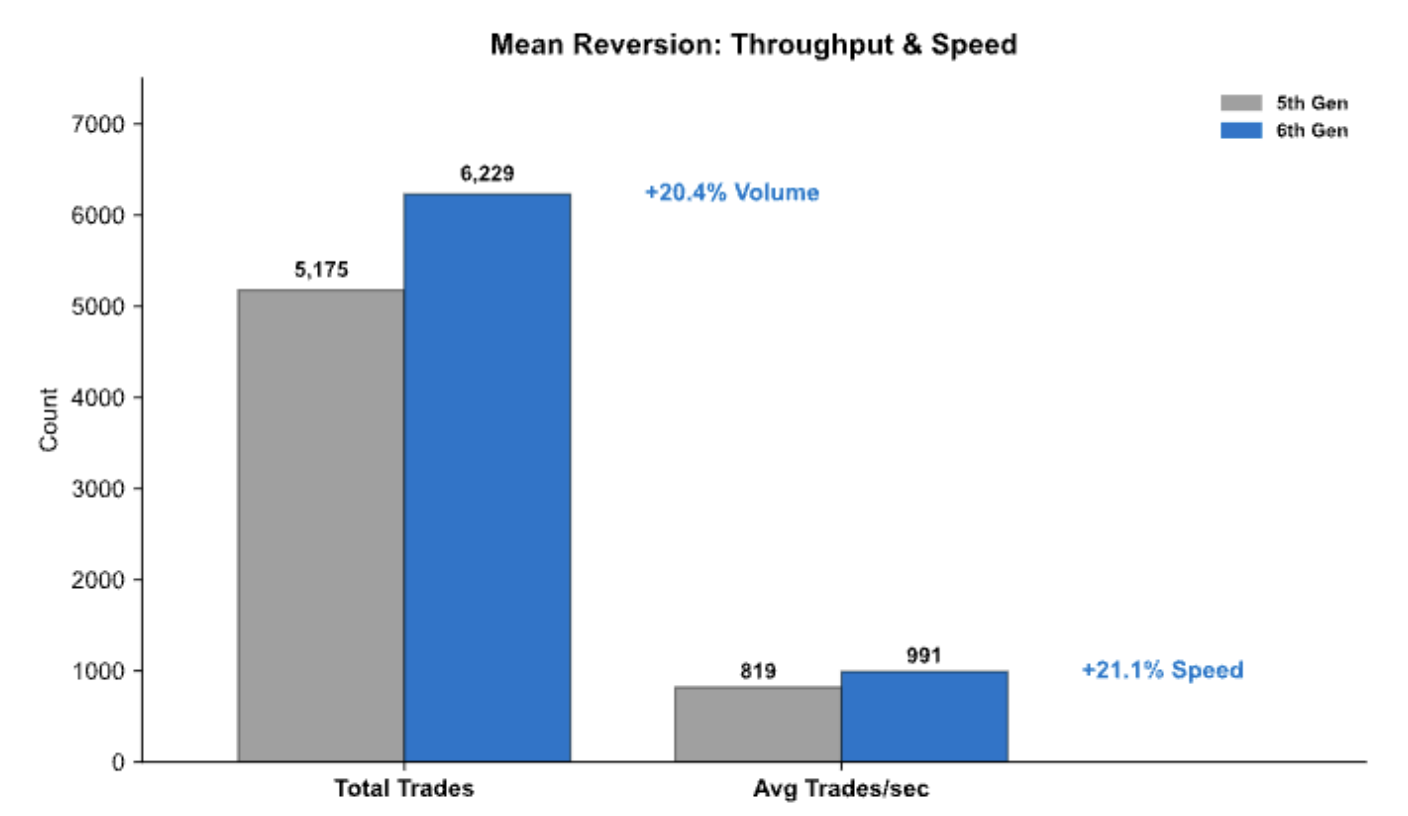
Figure 10. Simulated trade throughput for 5Min Mean Reversion. The 6th Gen executes 6,229 trades at 991 trades/sec versus 5,175 trades at 819 trades/sec (+20.4% volume, +21.1% speed).
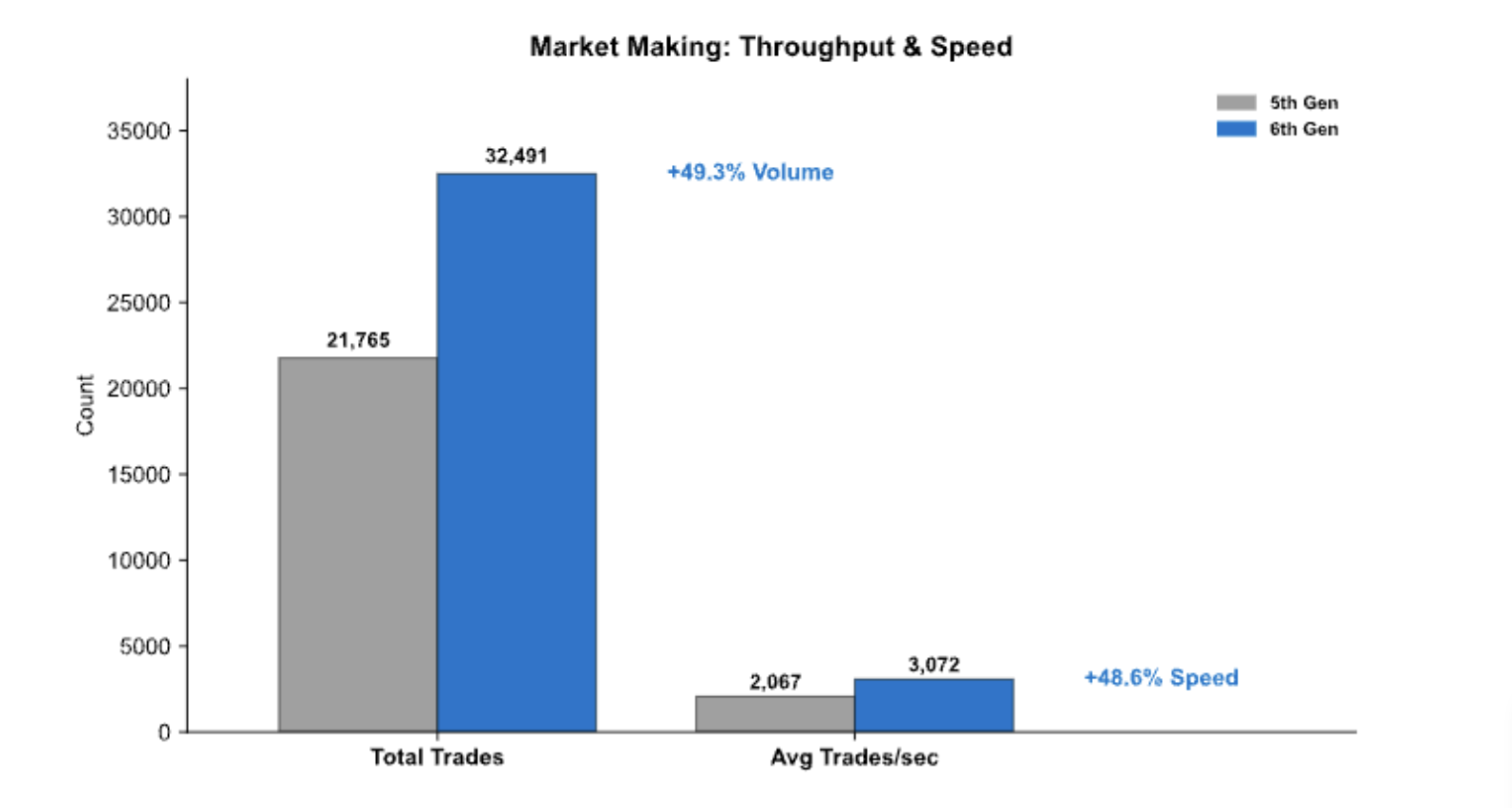
Figure 11. Simulated trade throughput for Market Making Spread. The 6th Gen executes 32,491 trades at 3,072 trades/sec versus 21,765 trades at 2,067 trades/sec (+49.3% volume, +48.6% speed).
Analysis
Generational improvement
The Intel Xeon 6980P reduces jitter by approximately 50% relative to the Intel Xeon 8592+. The Intel Xeon 6980P maintains p99 ~ 1.0 us, with over 99% of samples concentrated in the 1-2 us range. The Intel Xeon 8592+ exhibits a broader baseline distribution with meaningful tail events extending into the hundreds of microseconds.
Architectural scaling
The Intel Xeon 6980P delivers dramatically improved wake-up determinism while simultaneously doubling core density (256 total cores vs. 128 total cores in the 8592+). Traditional CPU design suggests that higher core counts should increase scheduling contention and worsen jitter. The Granite Rapids architecture breaks this pattern, maintaining sub-microsecond p99 latency with twice the parallelism.
Architectural implication
The 6th Gen Granite Rapids architecture achieves superior determinism through fundamental improvements in:
- Cache hierarchy: ~57% larger L3 cache (504 MiB vs. 320 MiB) reduces memory-access induced jitter
- Scheduler efficiency: Refined context-switch algorithms minimize OS overhead
This proves that execution determinism improvements scale through architecture, not at the expense of concurrency. The Intel Xeon 6980P delivers both tighter timing and greater computational throughput, eliminating the traditional trade-off between parallelism and predictability.
Strategy Performance Impact
To quantify how jitter affects trading outcomes, the platform injected measured timing distributions into strategy simulations using the HFTbacktest engine. Each strategy wake-up event sampled a delay from the appropriate CPU's jitter distribution, affecting signal evaluation timing, order submission, and queue interaction.
Throughput and Trade Velocity
Improved determinism translates directly to increased effective trading throughput by reducing stalled, delayed, or invalid order events. The doubled core count (256 vs. 128) further amplifies this advantage by enabling greater parallel strategy execution:
| Strategy | Trade Volume Increase |
|---|---|
| Market Making Spread with Adaptive Price Thresholds | +49.3% |
| 5 Min Mean Reversion | +20.4% |
The increase occurs because the Intel Xeon 6980P's tighter jitter distribution ensures more wake-ups fall within valid market micro-windows. The architectural improvements enable strategies to participate in more executable events per unit time through better timing consistency, while the doubled core density allows more strategies to run in parallel without resource contention.
Strategy Sensitivity Classification
Trading strategies exhibit fundamentally different sensitivities to execution timing:
| Strategy Class | Jitter Sensitivity | Primary Risk from Jitter |
|---|---|---|
| Probability Queue Models | Extreme | Invalid queue forecasts |
| Market Making (Adaptive) | Very High | Adverse selection, stale quotes |
| Mean Reversion | High | Missed reversals, reduced expectancy |
| Grid Trading | Medium-High | Inventory imbalance |
| Momentum / Directional | Medium | Slippage, missed entries |
| TWAP/VWAP Execution | Low | Minimal impact |
This classification enables hardware-to-strategy matching. Ultra-jitter-sensitive strategies (market making, queue models) benefit most from the Intel Xeon 6980P's compressed tail distribution, while multi-strategy clusters leverage both its determinism and doubled core density to run diverse portfolios in parallel.
AI Agent Backtest Analysis
Translating these performance metrics into deployment decisions requires synthesis across multiple dimensions: market conditions, risk exposure, and strategy-specific sensitivities. The platform's AI analysis layer automates this synthesis, transforming raw backtest output into a structured, decision-oriented assessment. It begins with market analysis, identifying prevailing regimes, sentiment, and detected patterns to provide context for strategy behavior. The system then performs a risk assessment, computing metrics such as Value at Risk (VaR), expected drawdown, and composite risk scores to quantify downside exposure. Next, it carries out strategy evaluation, comparing all tested strategies using a composite score that blends return, Sharpe ratio, and drawdown characteristics. Strategies are ranked objectively, with the top-performing approach clearly highlighted and recommended.
The final report generation tab brings everything together into a single, portfolio-level summary. It presents key portfolio details such as initial capital, number of positions, major holdings, and base currency. The AI generates a concise narrative explaining performance differences between strategies, highlighting trade-offs between return and risk. It also identifies concentration risks and proposes concrete adjustments, such as rebalancing position weights or setting drawdown limits. This final report transforms raw analytics into clear, actionable insights that support confident strategy deployment.
Conclusion
This evaluation demonstrates how the jitter-aware backtesting platform enables firms to quantify the relationship between CPU architecture and trading performance. By measuring wake-up latency jitter empirically and injecting those profiles into strategy simulations, the platform translates hardware characteristics into financial metrics that support infrastructure decisions.
The Intel Xeon 6980P processor on the Dell PowerEdge R770AP represents an upgrade for HFT workloads, delivering improved scheduling consistency while doubling computational capacity:
- p99 wake-up latency jitter reduced to approximately 1 us, roughly half that of the Intel Xeon 8592+
- Tail-latency events materially suppressed, reducing adverse selection and drawdown clustering
- Doubled core density across the dual socket system (256 total cores vs. 128 total cores) with improved determinism
The jitter-aware backtesting methodology enables firms to evaluate hardware upgrades using the same economic criteria applied to trading capital deployment. Rather than relying on synthetic benchmarks, infrastructure ROI is derived from measured changes in Sharpe ratio, return, throughput, and drawdown behavior under realistic execution conditions.
For latency-sensitive strategies, execution determinism can be as consequential to P&L as algorithm design itself. The Dell PowerEdge R770AP with Intel Xeon 6980P processor delivers a level of timing predictability that materially reshapes both profitability and risk exposure in high frequency trading environments.
The 6th Generation Granite Rapids architecture proves that determinism improvements are achievable through microarchitectural innovation. This is not at the expense of parallelism, but alongside a doubling of core density. This represents a fundamental shift in what trading infrastructure can deliver.
References
[1] Dell Technologies, Dell PowerEdge R770AP Rack Server. https://www.dell.com
[2] Intel Corporation, Intel Xeon 6 Processors. https://www.intel.com
[3] HFTbacktest library. https://github.com/nkaz001/hftbacktest
Copyright 2026 Metrum AI, Inc. All Rights Reserved. This project was commissioned by Dell Technologies. Dell and other trademarks are trademarks of Dell Inc. or its subsidiaries. Intel, Intel Xeon and related marks are trademarks of Intel, Inc. All other product names mentioned are the trademarks of their respective owners.
DISCLAIMER - Performance varies by hardware and software configurations, including testing conditions, system settings, application complexity, the quantity of data, batch sizes, software versions, libraries used, and other factors. The results of performance testing provided are intended for informational purposes only and should not be considered as a guarantee of actual performance. Financial return references mentioned in this paper are a example of simulated backtesting and are not indicative of future returns or performance.
Appendix A: Extended Jitter Profiling Results
Additional Resources
The Jitter numbers of the other Intel 6th Gen Xeon skus tested are as follows:
| CPU Model | ServerName | Thread Count(x2) | Min Jitter (ns) | p50 Jitter (ns) | p90 Jitter (ns) | p99 Jitter (ns) |
|---|---|---|---|---|---|---|
| Intel Xeon 6960P | Dell PowerEdge R770AP | 72 | 1052 | 1000 | 1000 | 1000 |
| Intel Xeon 6952P | Dell PowerEdge R770AP | 96 | 726 | 1000 | 1000 | 1000 |
| Intel Xeon 6972P | Dell PowerEdge R770AP | 96 | 1258 | 1000 | 1000 | 1000 |
| Intel Xeon 6978P | Dell PowerEdge R770AP | 120 | 644 | 1000 | 1000 | 1000 |
| Intel Xeon 6980P | Dell PowerEdge R770AP | 128 | 797 | 1000 | 1000 | 1000 |
The Device Details of the devices tested are as follows:
| CPU Name | ServerName | CPU Base Frequency (GHz) | CPU Max Turbo Frequency (GHz) | CPU Cache Memory (MiB) | TDP (Thermal Design Power) (W) | Total Cores | Total Threads | OSVersion |
|---|---|---|---|---|---|---|---|---|
| Intel Xeon 6960P | Dell PowerEdge R770AP | 2.7 | 3.9 | 432.0 | 500.0 | 144 | 144 | Ubuntu 24.04.3 LTS |
| Intel Xeon 6952P | Dell PowerEdge R770AP | 2.1 | 3.9 | 480.0 | 400.0 | 192 | 192 | Ubuntu 24.04.3 LTS |
| Intel Xeon 6972P | Dell PowerEdge R770AP | 2.4 | 3.9 | 480.0 | 500.0 | 192 | 192 | Ubuntu 24.04.3 LTS |
| Intel Xeon 6978P | Dell PowerEdge R770AP | 2.1 | 3.9 | 504.0 | 500.0 | 240 | 240 | Ubuntu 24.04.3 LTS |
| Intel Xeon 6980P | Dell PowerEdge R770AP | 2.0 | 3.9 | 504.0 | 500.0 | 256 | 256 | Ubuntu 24.04.3 LTS |
This section addresses common questions and considerations about the jitter-aware backtesting approach and methodology.
Frequently Asked Questions
Section 1: jitter-c Measurement Methodology
Q: Do isolated core measurements with real-time priority represent production conditions?
A: Production HFT systems typically use similar tuning: CPU isolation (via isolcpus kernel parameter) and real-time scheduling priority are standard practices for latency-critical trading applications. Differences between measurement conditions and production:
- Production workloads: Real trading systems have variable load, memory pressure, and competing processes.
- Thermal effects: Long-running production systems may experience thermal throttling not captured in short measurements.
- Background tasks: OS maintenance, logging, monitoring can introduce jitter not present in isolated measurements.
This demonstration uses controlled conditions to isolate CPU scheduling jitter characteristics, enabling apples-to-apples comparison between CPU architectures. Production deployments would experience additional jitter from these factors, but the relative differences between CPU architectures (e.g., 6980P vs. 8592+) would remain consistent.
Q: How accurate are the percentile calculations (p99, p99.9)?
A: jitter-c uses histogram-based percentile calculation, which has inherent characteristics:
- Histogram bins: Percentiles are computed from histogram bins with fixed edges.
- Approximation: Returns bin edge value rather than exact percentile value.
- Sample size: p99.9 percentiles require large sample sizes for robustness (typically 10,000+ samples).
- Measurement variability: Multiple measurement runs may show variation, particularly for p99.9 tail events.
For demonstration purposes, this approximation is sufficient to illustrate CPU architecture differences. Bin edges capture the overall distribution shape, and for hardware selection, relative comparisons (CPU A vs. CPU B) are more important than absolute percentile accuracy. When exact samples are available (using --store flag in jitter-c), exact sample data can be used for higher fidelity.
Section 2: Jitter Data Usage in Backtesting
Q: How do you reconstruct jitter distributions from histograms, and does this lose information?
A: The histogram reconstruction method converts histogram bins back into sample arrays by representing each bin's samples with the bin's left edge value. This is a lossy reconstruction that approximates the original distribution:
- Information loss: The actual distribution shape within bins is lost - all samples in a bin are represented by the same value.
- Approximation accuracy: This approximation is conservative for demonstration purposes but may not capture fine-grained distribution details.
- Why acceptable: For jitter-aware backtesting, the goal is to capture the overall distribution characteristics (percentiles, tail behavior) rather than exact individual sample values.
When exact samples are available (using --store flag in jitter-c), exact sample data can be used rather than histogram reconstruction for higher fidelity.
Q: Why use a lognormal distribution fitted to only p99 and max, rather than using the actual distribution?
A: The backtesting engine uses a lognormal distribution fitted to p99 and max latency values from the database. This approach:
- Database storage: Stores only summary statistics (p99, max), not full distributions.
- Distribution modeling: Lognormal distribution captures the right-skewed nature of jitter distributions.
- Tradeoff: Assumes a specific distribution shape that may not match the actual measured distribution.
Alternative approaches include using exact samples when available (requires larger database storage), fitting distributions to multiple percentiles (P50, P90, p99, p99.9) for better accuracy, or using kernel density estimation to model distribution shape more accurately. This demonstration prioritizes simplicity and database storage efficiency over perfect distribution fidelity. The lognormal approximation is sufficient to illustrate how CPU jitter differences affect strategy performance.
Q: Do the simulated jitter characteristics match the actual measured characteristics?
A: The lognormal fitting method is designed to match p99 and max characteristics. Full validation would require comparing simulated distribution statistics (mean, median, P50, P90, etc.) against measured values. This demonstration uses the approximation based on p99 and max characteristics to illustrate CPU architecture differences through strategy performance.
Section 3: Measurement-to-Execution Mapping
Q: How does wake-up latency jitter map to actual order execution delays?
A: Wake-up latency jitter is a component of execution delay, not the total delay. In HFT systems:
- Wake-up delay: Thread scheduling jitter (what jitter-c measures).
- Network delay: Market data packet processing, NIC handling.
- Processing delay: Strategy logic execution, data structure access.
- Memory delay: Cache misses, NUMA effects.
Total execution delay = Wake-up + Network + Processing + Memory.
This demonstration uses wake-up latency jitter as a proxy for CPU-induced execution delays. The backtesting engine applies measured jitter profiles to order execution timing to simulate how CPU architecture differences affect strategy performance. This mapping assumes that CPU scheduling jitter correlates with overall execution delay, which is reasonable because:
- CPU scheduling is a necessary first step for any execution.
- Lower scheduling jitter typically correlates with lower overall system jitter.
- For CPU-bound HFT strategies, scheduling jitter is often a dominant component.
The mapping assumes a proportional relationship between wake-up latency jitter and execution delay. Actual production systems may have different relationships depending on network configuration, memory architecture, and workload characteristics.
Q: How do you model slippage based on latency?
A: The backtesting engine uses a simplified slippage model:
- Time penalty: ~0.05 basis points per microsecond of latency (models queue position degradation).
- Size impact: Additional slippage based on order size relative to market depth.
Model assumptions:
- Latency directly correlates with order queue position (faster orders = better queue position).
- Queue position affects fill probability and price (being first in line = better execution).
- Order size relative to liquidity affects market impact.
Real market microstructure is more complex: queue position depends on many factors beyond latency (exchange matching algorithms, order types), market impact models depend on venue and time of day, and slippage varies significantly by market conditions. This demonstration uses a simplified model to illustrate the principle that CPU jitter affects execution quality. Production trading systems use market microstructure models appropriate to their exchange venues.
Q: Does CPU jitter directly cause performance differences, or is it correlated with other factors?
A: This demonstration shows correlation between CPU jitter characteristics and backtest performance differences. Establishing causation would require controlled experiments with all other factors held constant, statistical analysis to rule out confounding variables, and multiple measurements to establish statistical significance.
What this demonstration establishes:
- Different CPU architectures (6980P vs. 8592+) show measurably different jitter characteristics.
- When these jitter profiles are injected into backtests, strategies show different performance.
- The performance differences are consistent with the hypothesis that CPU jitter affects execution quality.
While this demonstration does not establish causation with rigorous statistical controls, the correlation is strong and consistent with HFT system behavior. The demonstration provides evidence that CPU architecture choice matters for latency-sensitive trading strategies.
Section 4: Backtesting Methodology
Q: Do the textbook strategies from HFTbacktest represent real professional trading strategies?
A: The included strategies are simplified examples designed to illustrate core trading concepts and demonstrate how CPU jitter affects different strategy types. Real professional quant strategies are significantly more complex, incorporating:
- Sophisticated risk models and position sizing.
- Multi-asset correlations and portfolio optimization.
- Proprietary alpha signals and machine learning models.
- Real-time risk management and circuit breakers.
- Exchange-specific order types and routing logic.
Why textbook strategies for this demonstration:
- Accessibility: Simple strategies illustrate core principles clearly.
- Illustration: They demonstrate core principles (momentum, mean reversion, market making) effectively.
- Framework: The backtesting infrastructure can accommodate professional strategies - this is an extensible demonstration.
Professional quants can plug their own strategies into this framework to evaluate CPU hardware selection for their specific strategies.
Q: How representative is the market data used in backtests?
A: This demonstration can use either:
- Generated market data: Synthetic tick streams created for repeatable scenarios.
- Historical market data: Real market data from financial data providers.
Characteristics:
- Market microstructure: Generated data may not capture real order book dynamics, tick size rules, or exchange-specific behavior.
- Historical data: Past market conditions may not represent future volatility, liquidity, or regime changes.
- Data quality: Historical data may have gaps, errors, or missing microstructure details.
The demonstration framework supports using historical market data that matches specific trading venues and time periods. Professional quants can extend the framework with production-grade market data sources.
Q: How do you validate that backtest results accurately predict production performance?
A: This demonstration does not validate backtest results against live trading. Validation would require running the same strategies in production with measured jitter profiles, comparing production P&L to backtest projections, and statistical analysis to establish predictive accuracy.
What this demonstration provides:
- A framework for evaluating hardware impact on strategy performance.
- Illustrative examples showing how CPU jitter affects different strategy types.
- Evidence that CPU architecture choice matters for latency-sensitive trading.
This framework can be used as one input to hardware evaluation, along with vendor benchmarks, architectural analysis, and pilot deployments with actual strategies and market data.
Section 5: Statistical Methodology and Comparison
Q: How statistically rigorous are the percentile calculations (p99, p99.9)?
A: The percentile calculations use histogram approximation, which has inherent characteristics:
- Histogram bins: Percentiles are computed from histogram bins with fixed edges.
- Approximation: Returns bin edge values rather than exact percentile values.
- Sample size: p99.9 percentiles require large sample sizes for robustness (typically 10,000+ samples).
- No confidence intervals: This demonstration does not compute statistical confidence intervals.
For demonstration purposes, this approximation is sufficient to illustrate CPU architecture differences. Bin edges capture the overall distribution shape, and for hardware selection, relative comparisons (CPU A vs. CPU B) are more important than absolute percentile accuracy. Production hardware selection may require multiple measurement runs per CPU configuration and statistical analysis to compute confidence intervals.
Q: How do you ensure apples-to-apples comparison between different CPU SKUs?
A: CPU comparisons require controlled conditions:
- BIOS configuration: Identical BIOS settings (performance mode, C-states disabled, etc.).
- OS configuration: Same OS version, kernel parameters, tuning.
- Workload: Same measurement workload (jitter-c with identical parameters).
- Environment: Dell server platforms (Dell PowerEdge R770AP or Dell PowerEdge R760), memory configuration, cooling.
Characteristics:
- Measurement variability: Even under controlled conditions, multiple runs may show variation.
- Statistical significance: Small differences (e.g., 6980P vs. 8592+) may be within measurement error.
- Constraining variables: Some system-level variables (thermal, background tasks) cannot be perfectly controlled.
Multiple measurement runs per CPU configuration would be required to establish statistical confidence in the differences.
Q: What exact system settings were used as test conditions for the wake-up-latency-jitter measurement using jitter-c?
A: The following table summarizes system settings used to measure wake-up-latency jitter using jitter-c:
| Component/Setting | Change Applied | Expected State / Verification Command |
|---|---|---|
| BIOS | ||
| System Profile | Set to "Maximum Performance" | Verified visually in BIOS/UEFI setup. |
| C-states | Disabled | Verified visually in BIOS/UEFI setup. |
| Hyper-Threading | Disabled | lscpu shows "Thread(s) per core: 1". |
| PCIe ASPM | Disabled | Verified visually in BIOS/UEFI setup. |
| Kernel | ||
| Core Isolation | isolcpus=4-127 | cat /proc/cmdline contains the parameter. |
| Timer Tick | nohz_full=4-127 | cat /proc/cmdline contains the parameter. |
| RCU Callbacks | rcu_nocbs=4-127 | cat /proc/cmdline contains the parameter. |
| Interrupt Affinity | irqaffinity=0-3 | cat /proc/interrupts shows activity only on CPUs 0-3. |
| Operating System | ||
| CPU Governor | Set to "performance" for all cores | cpufreq-info shows "governor 'performance'" for all cores. |
| Transparent Huge Pages | Disabled | cat /sys/kernel/mm/transparent_hugepage/enabled shows [never]. |
For more detailed info on the settings visit the Intel HFT - Xeon 6 Optimizations document.
Q: Are the performance differences between CPUs (e.g., 6980P vs. 8592+) statistically significant?
A: This demonstration does not establish statistical significance of CPU differences. To do so would require:
- Multiple measurements per CPU (e.g., 10+ runs).
- Statistical tests (t-test, Mann-Whitney U test) to compare distributions.
- Confidence intervals on percentile estimates.
- Power analysis to determine required sample sizes.
What this demonstration shows:
- Qualitative differences: Different CPUs show different jitter characteristics.
- Consistency: Differences are consistent with CPU architecture specifications.
- Practical significance: Differences are large enough to potentially affect strategy performance.
Statistical analysis with multiple measurement runs would be required to establish confidence in CPU performance differences before making procurement decisions.
Section 6: System Architecture and Integration
Q: How do you ensure end-to-end accuracy from jitter measurement to backtest results?
A: The system architecture includes several components:
- jitter-c: Measures CPU wake-up latency jitter.
- Database: Stores jitter profiles (p99, max latency).
- Backtesting engine: Loads profiles and injects jitter into simulations.
- Strategy execution: Applies jitter to order execution timing.
Characteristics:
- No end-to-end validation: This demonstration does not validate that backtest results accurately predict production performance.
- Integration assumptions: Assumes database storage/retrieval is accurate, backtesting engine correctly applies jitter.
- Workflow dependencies: Multiple components must work correctly together.
Production use may require validation tests for each component, end-to-end testing with known inputs and expected outputs, and comparison with production measurements when available.
Q: What are the assumptions and simplifications in this approach?
A: Key assumptions and simplifications:
- CPU jitter is a proxy for execution delay: Wake-up latency correlates with overall execution delay.
- Lognormal distribution: Jitter follows lognormal distribution (fitted to p99/max).
- Simplified slippage model: Linear relationship between latency and slippage.
- Textbook strategies: Simplified strategies represent production behavior for demonstration purposes.
- Market data: Generated or historical data captures relevant market characteristics.
- Measurement conditions: Isolated cores represent production conditions for CPU architecture comparison.
These simplifications enable a tractable demonstration that illustrates core principles. The framework is extensible - professional quants can replace simplified components with more sophisticated models. The demonstration shows that CPU jitter affects strategy performance, not necessarily exactly how much in production.
Professional quants should evaluate these assumptions for their specific strategies, market data, and production environments. The framework can accommodate more sophisticated models, real market data, and professional strategies to match production requirements.
Section 7: Potential Critiques
Q: Does jitter-c only measure wake-up latency jitter, not total execution time? Isn't this incomplete?
A: Yes, jitter-c measures only wake-up latency jitter, not total execution time. This is explicitly acknowledged in this FAQ, which states: "What jitter-c does NOT measure (out of scope for this blog): Network latency and jitter, Interrupt handling delays, Cache miss penalties, Memory access patterns, Application-level processing, Total end-to-end latency."
Why this limitation is acceptable: Wake-up latency is a necessary component of execution latency. As explained in an earlier section, "Wake-up latency is a necessary component of execution latency. When a trading system needs to process a market data update or execute an order, the thread must first be scheduled to run. CPU scheduling jitter directly contributes to execution delays - a thread that wakes up 10 µs late cannot execute faster than that delay allows."
Code ref: The jitter.c implementation measures only the delta between intended wake-up time and actual wake-up time using clock_nanosleep. It does not measure network processing, cache misses, or application logic execution time. This scope limitation is intentional - it isolates CPU scheduling jitter, which is a measurable characteristic that differentiates CPU architectures.
Q: Does histogram reconstruction lose important fine-grained distribution details?
A: Yes, histogram reconstruction is lossy and loses fine-grained details within bins. The histogram reconstruction method converts histogram bins back into sample arrays by representing each bin's samples with the bin's left edge value. This is a lossy reconstruction that approximates the original distribution: Information loss: The actual distribution shape within bins is lost - all samples in a bin are represented by the same value. The real world is always at least somewhat stochastic hence this is a reasonable, real world assumption.
Code ref: The jitter_sampler.py implementation reconstructs samples by representing each bin's samples with its left edge: val = edges[i-1] if i > 0 and i
Why this is acceptable: For jitter-aware backtesting, the goal is to capture overall distribution characteristics (percentiles, tail behavior) rather than exact individual sample values. When exact samples are available (using --store flag in jitter-c), exact sample data can be used for higher fidelity.
Q: Do measurement conditions (isolated cores, real-time priority) represent production conditions?
A: Measurement conditions differ from production in several ways. Production HFT systems typically use similar tuning: CPU isolation (via isolcpus kernel parameter) and real-time scheduling priority are standard practices for latency-critical trading applications.
Differences between measurement conditions and production: Production workloads i.e. Real trading systems have variable load, memory pressure, and competing processes. Thermal effects: Long-running production systems may experience thermal throttling not captured in short measurements. Background tasks: OS maintenance, logging, monitoring can introduce jitter not present in isolated measurements.
Why this is acceptable: Controlled conditions isolate CPU scheduling jitter characteristics, enabling apples-to-apples comparison between CPU architectures. Production deployments would experience additional jitter from these factors, but relative differences between CPU architectures (e.g., 6980P vs. 8592+) would remain consistent.
Q: Does this demonstration establish causation, or only correlation between jitter and performance?
A: This demonstration shows correlation, not causation. Establishing causation would require controlled experiments with all other factors held constant, statistical analysis to rule out confounding variables, and multiple measurements to establish statistical significance.
What the demonstration establishes: Different CPU architectures (6980P vs. 8592+) show measurably different jitter characteristics. When these jitter profiles are injected into backtests, strategies show different performance. The performance differences are consistent with the hypothesis that CPU jitter affects execution quality.
Further Clarification: The blog explicitly frames this as a "demonstration and illustration solution" that "illustrates" (not proves) how CPU jitter affects trading strategies. The methodology does not control for all confounding variables (CPU frequency differences, memory subsystem differences, thermal characteristics) that could independently affect performance.
Q: Is statistical significance established for CPU jitter differences?
A: No, statistical significance is not established. This limitation is explicitly acknowledged in Section 5, Q3: "This demonstration does not establish statistical significance of CPU differences. To do so would require: Multiple measurements per CPU (e.g., 10+ runs), Statistical tests (t-test, Mann-Whitney U test) to compare distributions, Confidence intervals on percentile estimates, Power analysis to determine required sample sizes."
What the demonstration shows: Qualitative differences (different CPUs show different jitter characteristics), consistency (differences are consistent with CPU architecture specifications), and practical significance (differences are large enough to potentially affect strategy performance).
Clarification: The blog acknowledges that "Even under controlled conditions, multiple runs may show variation" and that "Small differences (e.g., 6980P vs. 8592+) may be within measurement error". No statistical tests or confidence intervals are provided.
Q: Does the simplified slippage model capture real market microstructure?
A: No, the simplified slippage model is a simplification that does not capture real market microstructure complexity. This limitation is explicitly acknowledged in Section 3, Q2: "The backtesting engine uses a simplified slippage model: Time penalty: ~0.05 basis points per microsecond of latency (models queue position degradation), Size impact: Additional slippage based on order size relative to market depth... Real market microstructure is more complex: queue position depends on many factors beyond latency (exchange matching algorithms, order types), market impact models depend on venue and time of day, and slippage varies significantly by market conditions."
Code Ref: The jitter_simulator.py implementation uses a linear time penalty model (slippage_bps = latency_ns / 1e9 * 10000 * 0.05) that assumes a direct relationship between latency and slippage. Real market microstructure involves exchange-specific matching algorithms, order types, and dynamic queue position that cannot be captured by a simple linear model.
Why this simplification is acceptable: The demonstration uses a simplified model to illustrate the principle that CPU jitter affects execution quality. Production trading systems use market microstructure models appropriate to their exchange venues.
Q: Do the textbook strategies from HFTbacktest represent real professional trading strategies?
A: No, the included strategies are simplified examples that do not represent real professional trading strategies. The included strategies are simplified examples designed to illustrate core trading concepts and demonstrate how CPU jitter affects different strategy types. Real professional quant strategies are significantly more complex, incorporating: Sophisticated risk models and position sizing, Multi-asset correlations and portfolio optimization, Proprietary alpha signals and machine learning models, Real-time risk management and circuit breakers, Exchange-specific order types and routing logic.
To reiterate, the purpose is "illustration", not production accuracy.
Why this is acceptable: The blog acknowledges this limitation and positions the solution as "an extensible framework that professional quants can use to plug in and simulate their own proprietary strategies". The demonstration shows that CPU jitter affects strategy performance, not necessarily exactly how much in production with professional strategies.
Appendix B: What jitter-c Is and Why It Exists
What jitter-c Is and Why It Exists
jitter-c is a purpose-built Linux instrumentation tool developed by Metrum AI that measures wake-up latency jitter - the timing unpredictability that trading systems experience in production. Unlike existing measurement tools, jitter-c captures the execution characteristics that directly impact HFT strategy profitability: how consistently can a CPU execute time-sensitive code?
Why existing tools fall short: Traditional CPU benchmarks (SPEC, CoreMark) measure raw throughput or average latency - metrics that don't predict HFT profitability. Latency measurement tools typically capture network latency or average system response times, missing the critical wake-up latency jitter that causes execution delays. Performance profilers focus on overall performance characteristics rather than timing variability at percentile levels. These tools miss what HFT needs most: worst-case timing unpredictability measured through statistical distributions (P50, p99, p99.9) that map directly to trading outcomes.
The problem it solves: HFT cares about consistency, not average performance. A CPU that delivers 1us latency 99% of the time but 10ms latency 1% of the time will destroy strategy Sharpe ratios, even if average latency appears acceptable. Existing tools that report mean latency or throughput miss these tail-end events that determine real-world trading performance. jitter-c exposes this variability through percentile distributions that reveal the timing unpredictability HFT strategies actually experience in production.
How it works: The tool spawns threads pinned to specific CPU cores, schedules periodic wake-ups at nanosecond precision, and measures the delta between intended and actual wake-up time. This simulates what happens when HFT code tries to execute at precise intervals - the measured jitter reveals scheduler interference, cache misses, interrupt latency, and power management artifacts. jitter-c uses real-time scheduling, CPU affinity pinning, and nanosecond-precision timing to measure wake-up latency jitter with statistical distributions that directly map to trading outcomes.
Key technical capabilities:
- Real-time scheduling: Prioritizes threads over normal system processes for accurate measurements
- CPU affinity pinning: Binds threads to specific cores, isolating measurements per core
- Memory locking: Prevents page faults during measurement to avoid measurement artifacts
- Statistical analysis: Computes percentile distributions (P50, p99, p99.9) and histograms capturing jitter variability
Full implementation details and source code are available in the GitHub repository.
Practical Usage: Profiling Intel Xeon 6
jitter-c provides a straightforward command-line interface for profiling Intel Xeon 6 processors. A typical profiling command for Intel Xeon 6980P or 8592+ processors:
jitter-c profiles CPUs and outputs JSON-formatted results with statistical distributions including median, p99, and p99.9 jitter values. These measurements directly characterize each processor's timing consistency under HFT workloads.
Example profiling workflow: Teams profile multiple Intel Xeon SKUs (6980P, 8592+) under identical conditions to generate comparable jitter "fingerprints." The output includes percentile distributions and histograms that quantify timing variability - enabling direct comparison of how each processor performs under realistic workloads.
Interpretation of results:
- p99.9 jitter: Represents the worst-case execution delay 99.9% of the time - critical for HFT risk assessment
- Distribution shape: Tight distributions with low outliers indicate consistent performance
- Comparative analysis: Enables quantitative selection between 6980P and 8592+ based on workload-specific jitter budgets
Full usage documentation, example commands, and integration workflows are available in the GitHub repository.
Integration with Backtesting Workflow
The value chain: jitter-c measurements -> backtest simulator -> strategy performance
jitter-c produces JSON-formatted jitter profiles that integrate directly with backtesting engines. The backtesting engine loads these profiles and injects measured jitter distributions into order execution timing during simulation. When a strategy generates a trading signal, the simulator samples from the measured jitter distribution (e.g., from 6980P or 8592+ profiles) to model realistic execution delays, fill probabilities, and adverse selection.
This integration enables comparative analysis: teams run the same strategy backtest with different hardware jitter profiles (6980P, 8592+) to quantify performance differences attributable to CPU timing characteristics. The result is CPU-specific backtest outputs (Sharpe ratio, returns, fill rates) that directly answer hardware selection questions.
Full integration code, Python loaders, and backtesting engine implementation are available in the GitHub repository.
Why jitter-c Is Valuable for HFT Validation
1. CPU-Specific Performance Profiles
Unlike synthetic benchmarks, jitter-c captures the actual timing behavior of Intel Xeon 6 processors under HFT-like workloads. The p99.9 metric directly answers: "What's the worst-case execution delay my strategy will experience?"
2. Backtesting Realism
Traditional backtests assume zero execution latency or fixed delays. Real systems have variable latency. By injecting measured jitter distributions, backtests become predictive rather than optimistic. A strategy with Sharpe 3.0 in ideal backtests might show Sharpe 2.5 with Intel Xeon 8592+ processor jitter and Sharpe 2.7 with Intel Xeon 6980P processor jitter - quantifying the infrastructure ROI difference, such as $200K annual P&L improvement, that demonstrates the value of Intel Xeon 6 processor selection.
3. Hardware ROI Quantification
Infrastructure teams require evidence for hardware selection decisions. This demonstration provides it: the jitter distribution differences between Intel Xeon 6 SKUs - where the 6980P achieves approximately 50% lower p99 latency (approximately 1 us vs. 2-5 us) compared to the 8592+ - translate directly into backtest results showing Sharpe ratio improvements and annual P&L impacts, enabling ROI calculations that demonstrate infrastructure value. The 6980P also delivers doubled core density (256 total cores vs. 128 total cores), which can affect execution consistency in latency-sensitive trading strategies and enable greater parallel strategy execution.
4. Continuous Monitoring
The same tool used for pre-deployment profiling runs in production to detect configuration drift. If p99.9 degrades from baseline measurements, alerts trigger before trading performance suffers, ensuring production infrastructure maintains validated jitter characteristics.
5. Open-Source Transparency
Unlike vendor-supplied benchmarks, jitter-c source code is fully auditable. Trading firms can verify measurement methodology, adapt it to their needs, and trust results for regulatory documentation. Full source code and implementation details are available in the GitHub repository.
Comparison: jitter-c vs Existing Tools
Existing measurement tools fall short of HFT requirements in several critical ways. Generic CPU benchmarks like SPEC and CoreMark measure throughput and average latency but don't capture timing variability. Network latency tools focus on packet transmission delays rather than CPU wake-up jitter. System profilers measure overall performance but lack the nanosecond-precision and percentile analysis needed for HFT validation. jitter-c was specifically developed to fill these gaps.
| Metric | Generic Benchmarks / Existing Tools | jitter-c |
|---|---|---|
| What it measures | Raw throughput, average latency | Latency variability (jitter) |
| Relevance to HFT | Low (doesn't predict strategy performance) | High (directly models execution uncertainty) |
| Integration with backtesting | None | Native (JSON output feeds simulators) |
| Per-CPU granularity | No (system-level only) | Yes (isolates each core) |
| Percentile analysis | Rarely (usually just mean) | Always (P50, P90, p99, p99.9) |
| Real-time scheduling | No | Yes (SCHED_FIFO mimics trading threads) |
| Production monitoring | Not designed for it | Runs continuously in production |
jitter-c is built from source using standard build tools. A quick validation test measures jitter on a single CPU core and outputs JSON-formatted results with statistical distributions. For Intel Xeon 6 processors (6980P) and 5th Gen processors (8592+), expect p99.9 jitter values below 1.8 us with maximum spikes under 1ms - indicating excellent real-time characteristics suitable for HFT workloads.
Full build instructions, usage examples, and validation procedures are available in the GitHub repository.