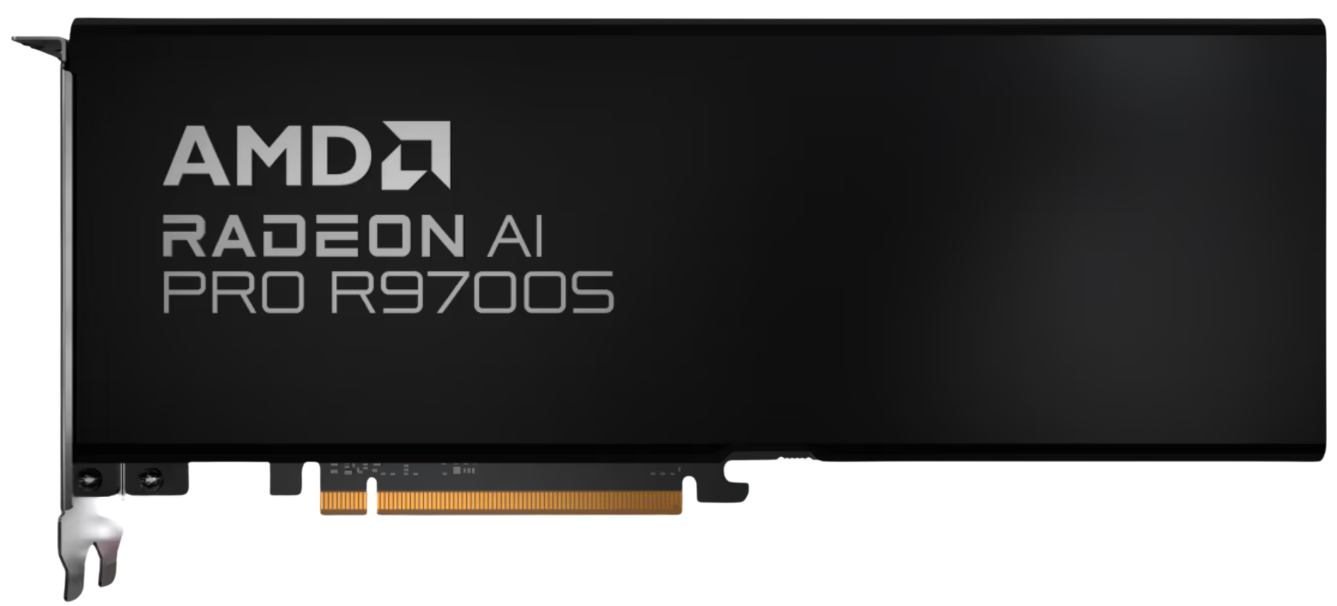
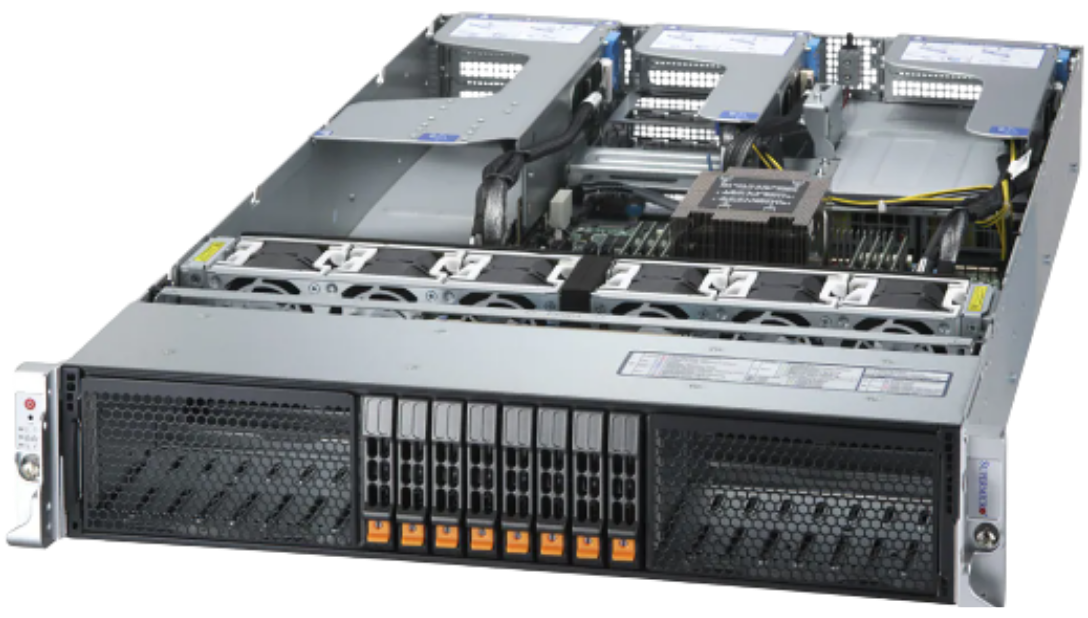
An on-premises, GPU-accelerated crowd analytics and incident reporting solution from Metrum AI, deployed on the Supermicro SuperWorkstation A+ Server AS -2115HV-TNRT with AMD Radeon™ AI PRO R9700S GPUs.
Prepared in collaboration with AMD and Supermicro.
Executive Summary
City operations teams already own the cameras. What they lack is the ability to watch all of them at once. Decoding and analyzing video is the constraint, and a CPU-only pipeline reaches its ceiling well short of a network that runs to hundreds of cameras. Most of the city stays unwatched. The streams that do get processed return raw counts with no situational context, which leaves operators to interpret numbers under time pressure.
Metrum AI built this solution to give operators one live view of crowd conditions across the whole network. It processes 50 concurrent camera streams in real time, detects people and vehicles, estimates crowd density, and raises alerts the moment a zone breaches its threshold. An on-premise agent layer then produces an incident report grounded in the city's own policy and standard operating procedures, complete with a zone state timeline and recommended actions.
Everything runs inside the city's own environment on a Supermicro SuperWorkstation A+ Server AS -2115HV-TNRT with AMD Radeon™ AI PRO R9700S GPUs and the AMD ROCm™ software stack. No video, no crowd data, and no imagery of the public leaves city infrastructure. Cities gain three advantages from that design: earlier intervention during crowd surges, an auditable record that ties every decision to written policy, and imagery that stays under city control, which is a simpler position to defend before a council or an oversight boar
This brief describes the operational problem, the solution, its architecture, and the outcomes city operations teams can expect. It is written for public safety directors, city CIOs and CTOs, transport authority operations leads, and infrastructure architects evaluating on-premises AI. The figures in this brief come from a Metrum AI demonstration on the reference configuration in Table 3, running the sample footage bundled with the solution repository.
The Business Challenge
Crowd incidents escalate in minutes. A transport concourse, a plaza, or an event entrance can move from busy to dangerous faster than an operator can page through camera feeds. Cities are expected to intervene early, and then to explain afterward exactly what they saw and what they did about it.
Where City Operations Lose Ground Today
The gap is not a shortage of cameras or a shortage of staff. Four structural limits recur across city operations centers, and each one carries a public cost.
| Operational Gap | Business Consequence |
|---|---|
| Monitoring capacity falls short of camera count | CPU-only processing reaches its ceiling well short of a network that runs to hundreds of cameras. Most of the city stays unwatched, and the cameras that matter during an incident are often the ones nobody had on screen. |
| Detection produces counts without context | A number on a dashboard does not tell an operator whether a crowd is dispersing or compressing. Staff spend the critical minutes interpreting data rather than directing a response. |
| Overcrowding surfaces after the fact | Teams learn about a surge once it has already formed. The window for a low-cost intervention, such as opening a gate or redirecting flow, has closed. |
| Response is disconnected from written policy | Operators act on judgment while the city's standard operating procedures sit in documents nobody can consult mid-incident. After-action reviews then struggle to show that policy was followed. |
Table 1. Recurring gaps in city crowd monitoring and their operational consequences
Why Cloud-First AI Falls Short for Public Space Video
Video analytics answers these gaps, and many vendors deliver it as a cloud service. For public sector video, that architecture runs into three problems at once.
- Procurement rules often rule it out. Many cities operate under security and data residency requirements that prohibit sending public space video to a third-party cloud. The evaluation ends before the technology is assessed.
- Cost scales with coverage. Per-stream and per-inference pricing means every camera added raises the recurring bill, which puts the budget in direct conflict with the goal of watching more of the city.
- Public trust is harder to defend. Video of citizens in public spaces attracts legitimate scrutiny. A system that keeps imagery inside city infrastructure is far easier to explain to a council, an oversight board, or a records request.
Running inference locally removes all three objections at once, and it also removes the round trip that delays an alert.
The Market Shift: Coverage and Accountability Together
Three developments have made city-scale crowd intelligence practical on hardware a single operations center can host.
- GPU-accelerated pipelines break the stream ceiling. Detection and density estimation run concurrently across dozens of feeds on a handful of workstation GPUs, so coverage is set by the size of the camera network rather than by the compute budget.
- Retrieval grounds AI output in the city's own rules. Semantic search over policy documents lets a report cite the procedure that applies, which turns a generated summary into something an oversight body can review.
- Agentic AI writes the incident record. Software agents gather the evidence, assemble the timeline, and draft the report, so an analyst reviews a drafted record instead of assembling one.
Coverage and accountability used to compete for the same budget. These shifts let a city fund both.
Solution Overview
The solution delivers a unified, on-premises view of crowd conditions across a camera network. It continuously monitors every connected stream, detects people and vehicles, estimates crowd density, and classifies each zone by severity. When a zone breaches its critical threshold, the system surfaces the feed automatically with a density heatmap overlaid on the frame.
Operators work from one dashboard with two modes. Live Operations carries the city map with highlighted critical zones, the processed camera grid, and live GPU telemetry. Analytics carries the rolling 30-day view, crowd count trends, recurring pattern panels, and on-demand incident report generation.
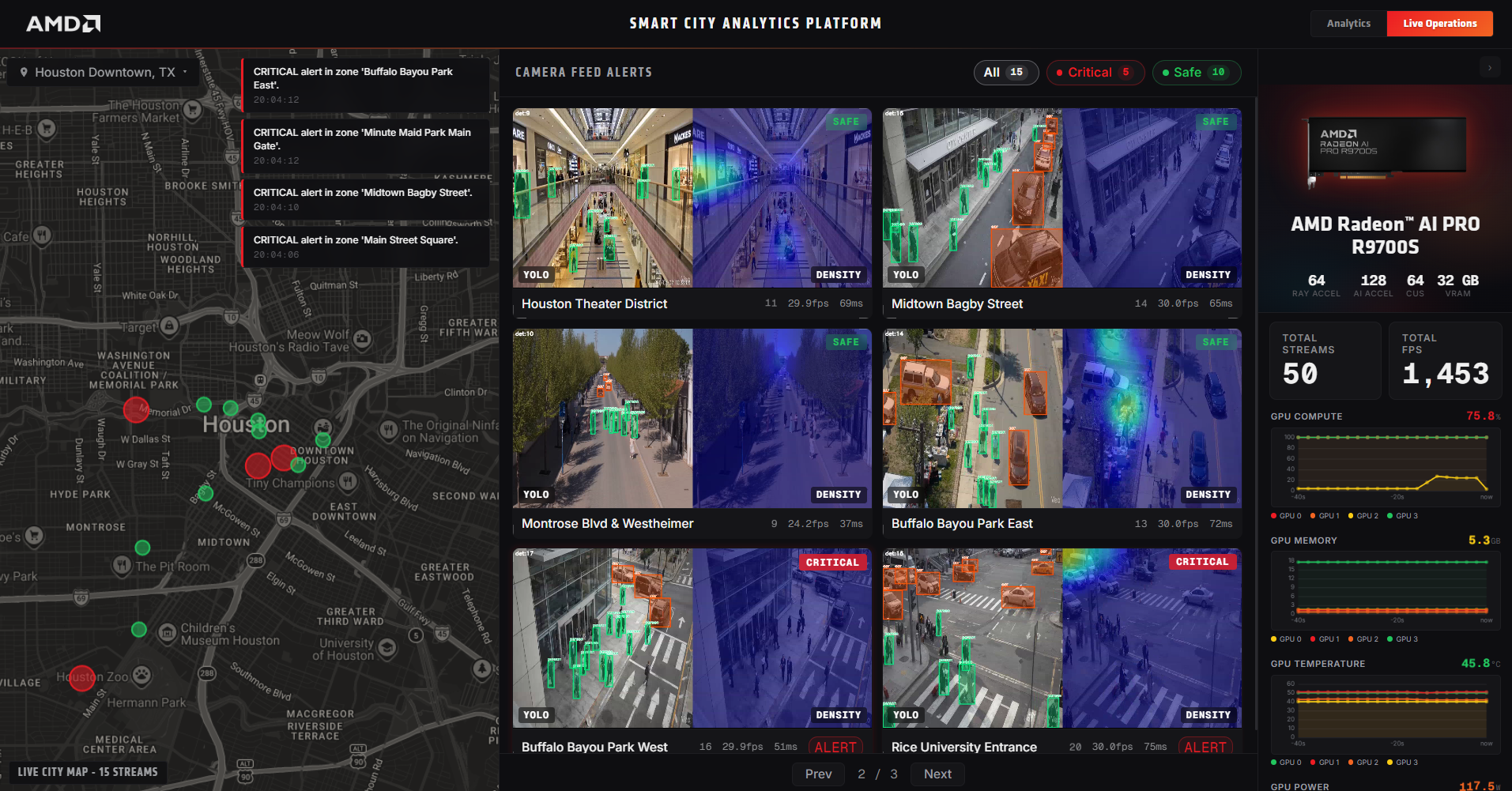
Figure 1. Live Operations combines the city map, the processed camera grid, and live GPU telemetry on one screen
Simulated data. Locations and events depicted are illustrative.
Capability Highlights
| Capability | What It Delivers |
|---|---|
| GPU-accelerated video intelligence | 50 concurrent camera streams processed in real time, combining object detection and crowd density estimation on AMD Radeon™ AI PRO R9700S GPUs with the AMD ROCm™ stack. |
| Real-time alerting without operator action | A threshold breach immediately surfaces the affected stream with a heatmap overlay, raises an alert banner, and pulses the zone marker on the map. Nobody has to be watching the right tile. |
| Policy-grounded agentic reporting | The AMD GAIA agent framework coordinates an evidence agent over the time-series alert history and a policy agent over the city's own procedure library, then produces a report with a zone state timeline and recommended actions. |
| On-premise language model serving | A compact open-weight model runs locally through vLLM on AMD ROCm™, so report generation carries no cloud dependency and no external data transfer. |
| City-scale awareness metrics | A unified dashboard covers live stream health, detection latency, crowd metrics, and system indicators, with the rolling 30-day analytics view for pattern analysis across zones. |
| Exportable incident record | Reports render to a downloadable PDF that carries its classification, source zone, time range, and evidence, ready for after-action review or a records request. |
Table 2. Capability highlights and the operational value each one delivers
How the Solution Works
The solution follows a four-stage pipeline that runs continuously on the local system.
- Capture. A media server ingests camera streams from public spaces, transport hubs, and event venues. A hardware-accelerated video pipeline decodes each feed for analysis.
- Perceive. Object detection locates people and vehicles in every frame while a density estimation model produces the crowd heatmap. Both models run on the AMD Radeon™ AI PRO R9700S GPUs through the AMD MIGraphX ONNX runtime.
- Classify and alert. A threshold engine scores each zone and assigns a severity of critical or safe. Breaches surface immediately in the dashboard with the heatmap and the alert banner, without waiting for an operator to notice.
- Investigate and report. On request, the agent layer queries the alert history for evidence, retrieves the applicable policy excerpts, and authors a structured incident report that renders to PDF.
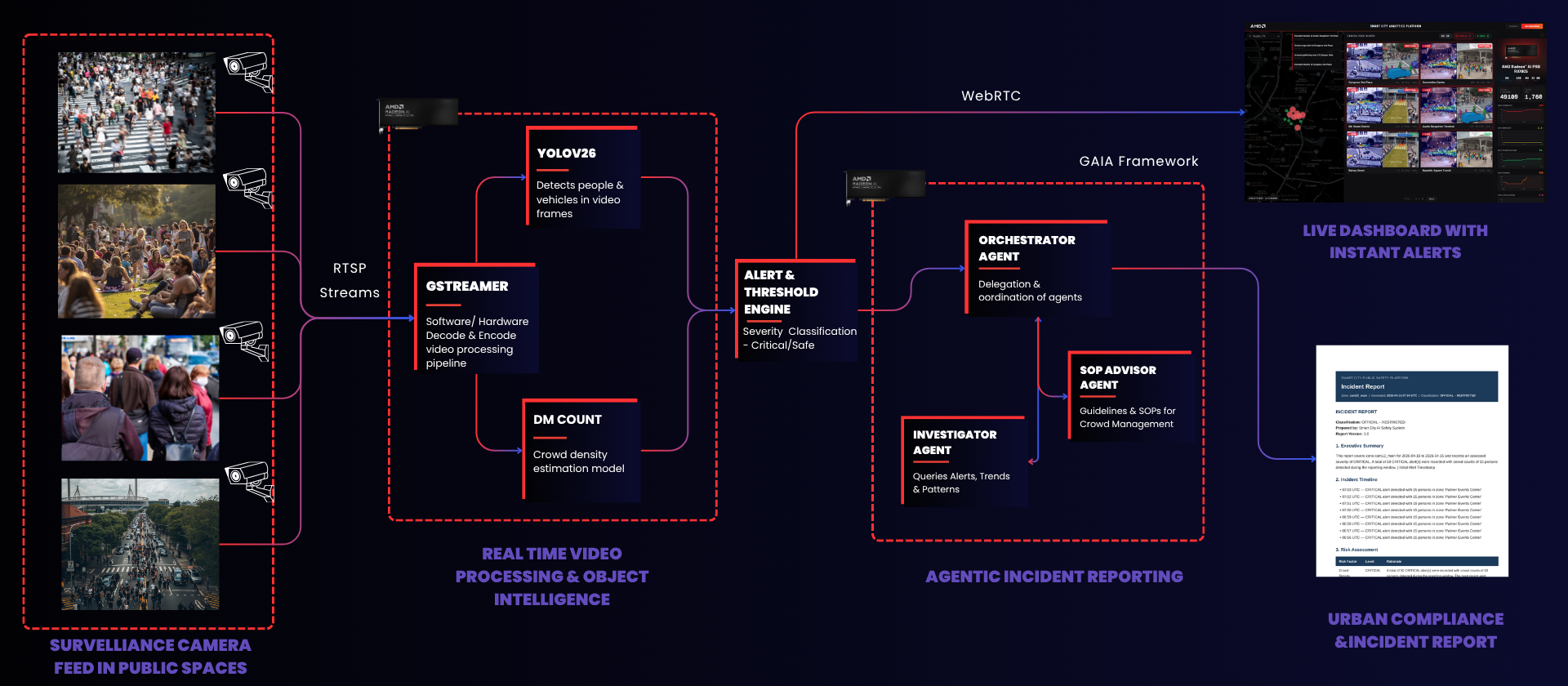
Figure 2. Solution workflow, from surveillance feeds through detection and alerting to the agent-authored incident report
The reporting path is what separates this solution from a detection system. An operator selects a zone and a time range, and the agent layer returns a classified report that names what happened, when each zone changed state, which procedure applies, and what action the procedure recommends. That output arrives in about a minute.
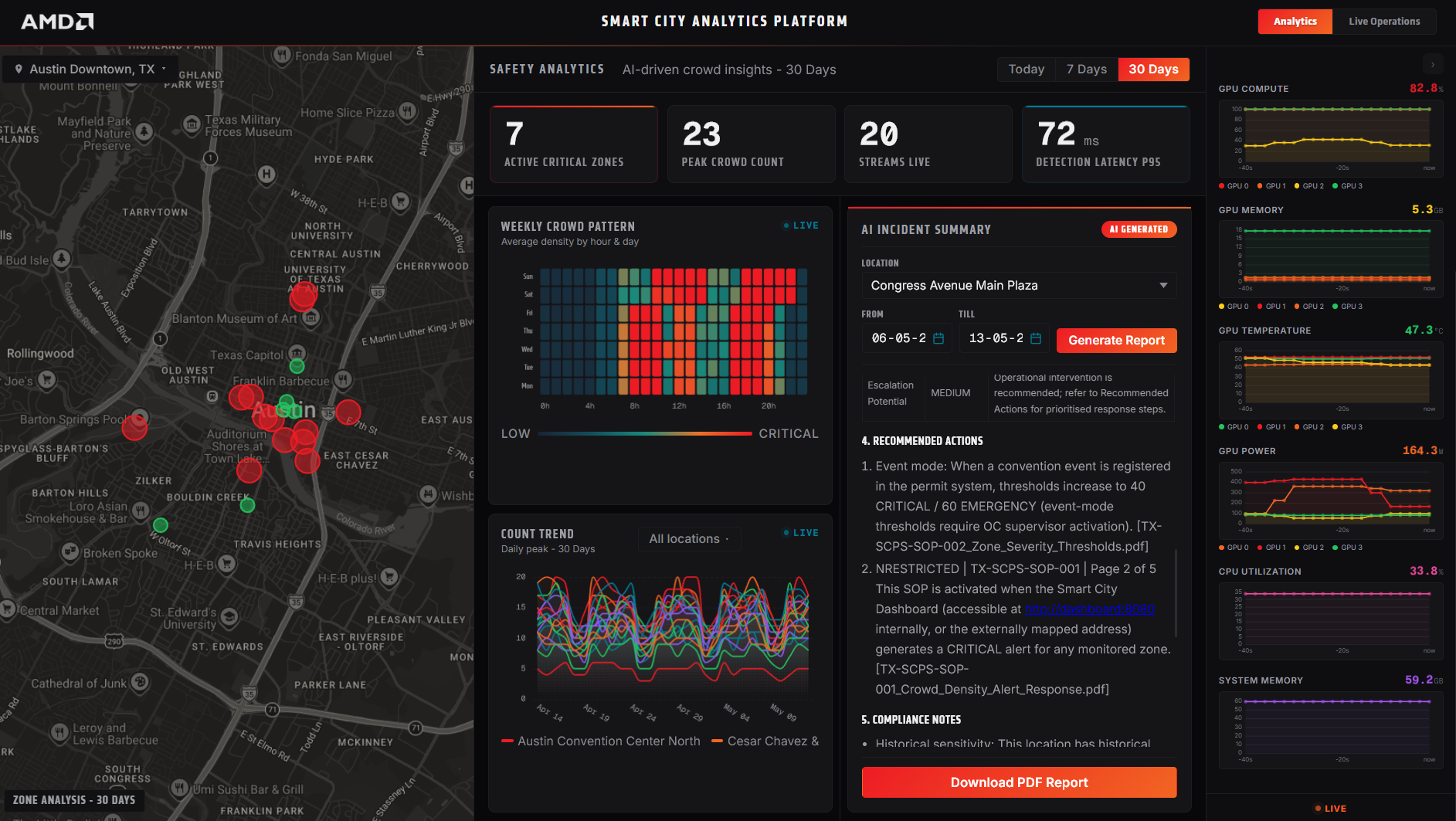
Figure 3. The Analytics view pairs 30-day crowd patterns with an on-demand, policy-grounded incident report
Simulated data. Locations, policies, and events depicted are illustrative.
Solution Architecture
The architecture layers a video perception pipeline, an alerting service, an agentic reasoning layer with retrieval, and a web dashboard on top of AMD ROCm™ and a containerized service stack. A time-series database holds alert history, and a vector database holds the city's indexed policy library. Every layer runs on the same local system, and the deployment uses standard container tooling so city IT teams manage it with tools they already know.
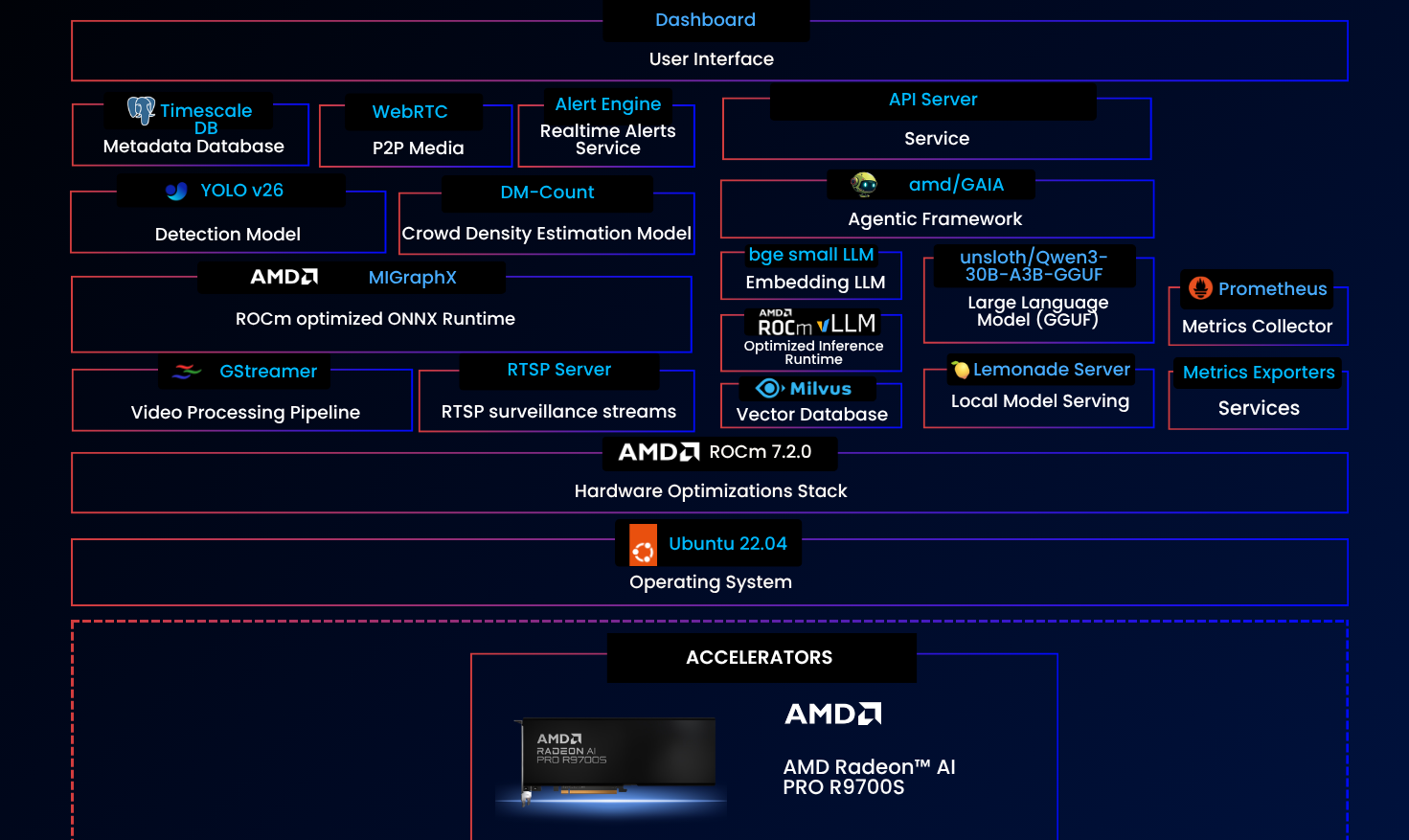
Figure 4. Solution architecture, from hardware and AMD ROCm through perception, alerting, agents, and dashboard
Reference Configuration
The following configuration is the recommended starting point for this workload and the system Metrum AI used for the demonstration described in this brief. The demonstration ran the four-GPU profile. A two-GPU profile is supported for smaller deployments at proportionally lower stream capacity.
| Component | Specification |
|---|---|
| System platform | Supermicro SuperWorkstation A+ Server AS -2115HV-TNRT, 2U single-processor rackmount workstation with PCIe 5.0 |
| GPUs | 2 x or 4 x AMD Radeon AI PRO R9700S, 32 GB per GPU |
| Processor | AMD Ryzen™ Threadripper™ PRO series, 96 cores |
| System memory | 256 GB DDR5 |
| Storage | 2 TB NVMe SSD |
| Operating system | Ubuntu 22.04 LTS or Ubuntu 24.04 LTS |
| GPU software stack | AMD ROCm™ 7.2 with the AMD MIGraphX ONNX runtime |
| Container runtime | Docker Engine 24.0 or later with Docker Compose v2.20 or later |
Table 3. Reference hardware and software configuration used for solution deployment and validation
The R9700S is the passively cooled variant of the Radeon AI PRO R9700, built for the directed chassis airflow of a rackmount system rather than the open airflow of a desktop workstation. That is why four of them fit a 2U node.
Business Outcomes
City operations teams evaluate this class of technology on coverage per dollar, response time, and defensibility. The solution addresses all three.
- Coverage that matches the camera network. One node watches 50 streams, so existing camera investment produces monitored coverage rather than recorded footage.
- Intervention while it is still cheap. Automatic alerts surface a forming surge without operator action, which preserves the window for low-cost measures such as opening a gate or redirecting pedestrian flow.
- Auditable, policy-grounded records. Every report cites the procedure that applies and shows the evidence behind its severity assessment, which strengthens after-action review and records responses.
- Analyst time returned to operations. Report assembly moves from hours of manual work to an on-demand request, so staff spend their shift directing response rather than reconstructing it.
- Predictable economics. Inference runs on hardware the city owns, so cost does not scale with stream count or per-inference cloud pricing.
- Full data sovereignty. Video, crowd data, and citizen imagery stay inside city infrastructure, which simplifies privacy review and supports data residency requirements.
Deployment Model and Next Steps
The solution deploys as a containerized stack on a single system, and a guided setup routine validates the GPU environment, prepares configuration, selects the two-GPU or four-GPU profile, and starts every service. Cities typically move through three phases.
- Validate. Stand up the reference configuration against representative footage from your own zones to confirm detection accuracy, threshold behavior, and alert flow for your scene types and camera angles.
- Integrate. Connect live camera streams, then load your standard operating procedures and policy documents into the retrieval index so generated reports cite your rules rather than sample content.
- Scale. Extend coverage by adding nodes, each running the same containerized stack, and extend zones and camera groups per node, tune thresholds per location, and add agents for the workflows your operations center values most.
To scope a deployment for your operations center, or to arrange a technical walkthrough of the Live Operations and Analytics views, contact Metrum AI or your AMD and Supermicro account teams.
Appendix A: Agent Layer Detail
The agent layer runs on the AMD GAIA framework and activates when an operator requests a report. Each agent holds a narrow scope and a defined data source, which keeps the output traceable to specific evidence rather than to a general model impression.
| Agent | Role |
|---|---|
| Orchestrator Agent | Single entry point for a report request. Delegates to the Investigator and the SOP Advisor, then synthesizes their findings into the prompt the local model answers. |
| Investigator Agent | Evidence analyst. Pulls alerts, density trends, zone state timelines, and recurring patterns from the time-series database for the selected zone and time range. |
| SOP Advisor Agent | Policy analyst. Retrieves the relevant standard operating procedure and policy excerpts from the vector index using semantic search, so recommendations cite the city's own rules. |
Table 4. Agent roles in the on-premises reasoning layer
The resulting report carries a classification, the preparing system, a version, an executive summary, an incident timeline, and a risk assessment. It renders to a downloadable PDF for distribution and archival.
References
| 1. | AMD. "AMD Radeon AI PRO R9700 Graphics." https://www.amd.com/en/products/graphics/workstations/radeon-ai-pro/ai-9000-series/amd-radeon-ai-pro-r9700.html |
| 2. | AMD. "AMD ROCm Documentation." https://rocm.docs.amd.com |
| 3. | AMD. "GAIA: Build AI agents that run locally." https://github.com/amd/gaia |
| 4. | Supermicro. "SuperWorkstation A+ Server AS -2115HV-TNRT." https://www.supermicro.com/en/products/system/superworkstation/2u/as-2115hv-tnrt |
| 5. | Metrum AI. Smart City Public Safety solution repository documentation and release notes. |
| 6. | Image sources: Live Operations and Analytics dashboard captures from the solution repository. Product imagery courtesy of AMD and Supermicro. |
Disclaimers
Performance
Performance varies by hardware and software configuration, including testing conditions, system settings, application complexity, data quantity, batch sizes, software versions, and libraries used. Any performance figures referenced in this document are provided for informational purposes only and should not be interpreted as a guarantee of actual performance.
Model Performance Limitations
This solution is a technology demonstration validated against the sample footage bundled with the solution repository. Those clips represent the scene types, camera angles, and crowd density ranges for which the pipeline has been evaluated and tuned. Both models carry known accuracy boundaries. Object detection becomes less reliable in very dense crowd scenes, and density estimation becomes less reliable in very sparse scenes. For other footage or external camera streams, accuracy is not guaranteed and may produce significant over-counting or under-counting, missed detections, or spurious alerts. Results should be treated as indicative rather than authoritative.
Data and Legal
The policy documents and video clips used in demonstrations are simulated and illustrative. They do not represent actual organizational policies, procedures, or real event footage, and they should not be relied upon for operational, legal, or real-world decision-making. Deployments that process video of public spaces may be subject to privacy, surveillance, civil liberties, and public records requirements that vary by jurisdiction. Operators should confirm their compliance obligations, retention policy, and any public notification duties before production use. All materials are supplied as-is without warranties of any kind.
AMD, the AMD Arrow logo, Radeon, Ryzen, Threadripper, ROCm, MIGraphX, and combinations thereof are trademarks of Advanced Micro Devices, Inc. Supermicro, SuperWorkstation, and A+ Server are trademarks or registered trademarks of Super Micro Computer, Inc. All other product names are used for identification purposes only and may be trademarks of their respective owners.
METRUM AI INC. 2026 © All rights reserved.