Accelerating Hybrid Post-Quantum Payment Signing on the Dell PowerEdge™ R770 Rack Server with Intel® Xeon® 6 Processors and Integrated Intel® QuickAssist Technology
Executive Summary
Payment security is entering its first algorithm transition in a generation. Post-quantum cryptography (PQC) uses new algorithms designed to stay secure even against future quantum computers, which could break the RSA signatures that protect payments today. The U.S. National Institute of Standards and Technology (NIST) has standardized post-quantum signatures and proposed deprecating 112-bit RSA after 2030, and U.S. and European guidance sets migration milestones between 2030 and 2035, so financial institutions are adding quantum-safe signatures to payment flows now. The practical path is hybrid signing, which signs every payment instruction with both a post-quantum algorithm and RSA, so existing verifiers keep working. At millions of instructions per batch, that double cryptographic work becomes a measurable overhead: CPU cycles shift to signing, batch windows stretch, and power consumption rises with them.
The Dell™ PowerEdge™ R770, configured with Intel® Xeon® 6 6760P processors and integrated Intel® QuickAssist Technology (Intel QAT), reduces that overhead at the platform level. By offloading the RSA-2048 half of each hybrid signature to dedicated QAT engines, enterprises sign, transmit and acknowledge more than twice as many quantum-safe payments per signing CPU while lowering CPU package energy per payment on the measured socket. Benchmark results compare four cryptographic configurations under an identical payment workload, giving infrastructure leaders a like-for-like measured comparison to inform platform evaluation.
Key Results at a Glance
- 2.21x payment throughput. Hybrid PQC with Intel QAT (QAT ON) against hybrid PQC with QAT OFF (OpenSSL default RSA), at 8 logical sender CPUs.
- Up to 3.06x at 2 logical sender CPUs. The gain grows as fewer logical CPUs are assigned to signing.
- 54.8% shorter batch window. One million payments signed and acknowledged in 52.5 seconds instead of 116.2 seconds.
- 34% shorter batch than classical RSA in software. Hybrid signing with QAT completed the one-million-payment batch in 52.5 seconds, against 79.3 seconds for classical RSA-2048 signing with QAT OFF, measured in a separate session.
- 52% lower CPU energy per payment. Socket 1 CPU package energy above idle, at 8 logical sender CPUs; the two QAT devices on socket 0 are not included.
Quantum-Safe Payments Without Throttling Throughput
Every high-volume payment flow depends on digital signatures: payment files carry signed instructions to banks, banks return signed status reports, and both sides keep those records for audit and dispute resolution.
What post-quantum cryptography is and why it matters now
Payment signatures today rely on RSA and elliptic-curve cryptography, whose security rests on math problems that classical computers cannot solve in any practical time. A large enough quantum computer could solve them, letting an attacker forge signatures and decrypt recorded traffic. No such machine exists today and no one can say when one will, but two risks apply now: data captured today can be decrypted later ("harvest now, decrypt later"), and signed records kept for years for audit and dispute resolution lose their value as evidence once RSA signatures can be forged. Post-quantum cryptography replaces these algorithms with new ones built on problems, such as structured lattices, that are believed to be hard for both classical and quantum computers. PQC runs on today's servers and needs no quantum hardware.
NIST published the Module-Lattice-Based Key-Encapsulation Mechanism (ML-KEM) as FIPS 203 and the Module-Lattice-Based Digital Signature Algorithm (ML-DSA) as FIPS 204 in August 2024 [1][2], and its draft transition plan, NIST IR 8547, proposes deprecating 112-bit RSA signatures after 2030 and disallowing them after 2035 [3]. Migration across counterparties takes years, so the work has to start now.
Why hybrid signing cost matters at payment scale
Hybrid signing puts two signatures on every payment instruction: a quantum-safe one (ML-DSA-65) and a traditional one (RSA-2048). The bank accepts the payment only when both check out. This protects the transition in two ways: banks that cannot yet check the new signature can still check the RSA one, and if either algorithm is ever broken, the other still protects the record.
Regulators are setting deadlines for this move:
- France (ANSSI, the French National Agency for the Security of Information Systems): hybridization, including for signatures, is required in products evaluated for an ANSSI security visa during its second transition phase [4].
- Germany (BSI, the Federal Office for Information Security): classical-only signatures are no longer recommended after 2035 [5].
- U.S. federal agencies (Office of Management and Budget memo M-26-15): post-quantum signatures for high-value assets and high-impact systems by the end of 2031 [6].
- U.S. federal contractors (Executive Order 14412): the Federal Acquisition Regulation (FAR) Council is directed to propose a rule requiring covered contractors to comply with NIST's post-quantum standards by 31 December 2030 [7].
The price is two signatures per payment, and the RSA signature is the more expensive of the two on general-purpose CPUs.
Without QAT offload, this creates three compounding problems for infrastructure teams:
- Batch-window ceiling. Signing consumes the cores that release payment files, stretching batch completion against settlement cut-off times.
- Stranded compute. Cores pinned to signing cannot serve payment validation, fraud screening or reconciliation, leaving expensive silicon working on cryptography instead of the business.
- Energy per payment. Software signing keeps cores busy longer for every batch, which raises CPU energy and operating cost per payment.
The measured gap is concrete. On eight logical sender CPUs, hybrid signing with QAT OFF processed 8,609 payments per second against 52,135 for classical RSA signing with QAT, and a one-million-payment batch took 116 seconds instead of 19. Part of that gap is the algorithm change itself: classical RSA with QAT OFF, measured in a separate session, ran at 12,610 payments per second, so in software hybrid signing makes the batch 46% longer (79.3 seconds to 116.2 seconds). Hybrid with QAT, at 19,055 payments per second, is faster than that classical software signer.
Hardware-Accelerated Hybrid Signing on Dell PowerEdge R770
Dell PowerEdge R770 servers with Intel Xeon 6 6760P processors expose Intel QAT as an integrated accelerator for symmetric and asymmetric cryptography. When OpenSSL routes RSA private-key operations through the QAT provider, RSA signing moves off general-purpose cores and onto dedicated QAT engines. ML-DSA stays on the Xeon cores. The split follows Intel's published design for hybrid post-quantum cryptography, in which QAT accelerates the traditional portion and oqs-provider supplies the quantum-resistant algorithms [8].
That split targets the expensive half of the work. Offloading only the RSA-2048 operation cut the signing stage by 68.4% at eight logical sender CPUs, which means RSA consumed at least two thirds of hybrid signing time with QAT OFF. The cut is 72% at two logical sender CPUs.
Configuration | Type | Role in this evaluation |
(1) Classical + Intel QAT | X25519 key exchange, RSA-2048 signature | Classical starting point for the migration |
(2) Hybrid PQC, QAT OFF | X25519MLKEM768, ML-DSA-65 + RSA-2048, software | Software-only hybrid baseline (OpenSSL default RSA) |
(3) Hybrid PQC + Intel QAT (QAT ON) | Same algorithms, RSA leg offloaded | Same stack with RSA offload to QAT engines |
(4) Full PQC, NIST Level 5 | ML-KEM-1024, ML-DSA-87, software | All-PQC endpoint, shown for context |
Table 1 | Cryptographic configurations evaluated.
Why this comparison matters
The hybrid pair is the comparison. The other two configurations are context, from the same test matrix:
Logical sender CPUs | Classical + QAT | Hybrid, QAT OFF | Hybrid + QAT (QAT ON) | Full PQC Level 5 |
8 | 52,135 | 8,609 | 19,055 | 19,366 |
4 | 50,777 | 4,748 | 12,352 | 12,808 |
2 | 37,415 | 2,512 | 7,677 | 7,707 |
Batch time at 8 CPUs (seconds) | 19.2 | 116.2 | 52.5 | 51.6 |
Table 2 | Payments accepted per second by configuration and logical sender CPU count, one-million-payment batches.
Payments accepted per second, one million instructions, median of three repetitions; the last row is batch completion time at eight logical sender CPUs. 19,055 is the median of the reported test run; the same configuration measured 18,871 and 19,021 in two earlier sessions.
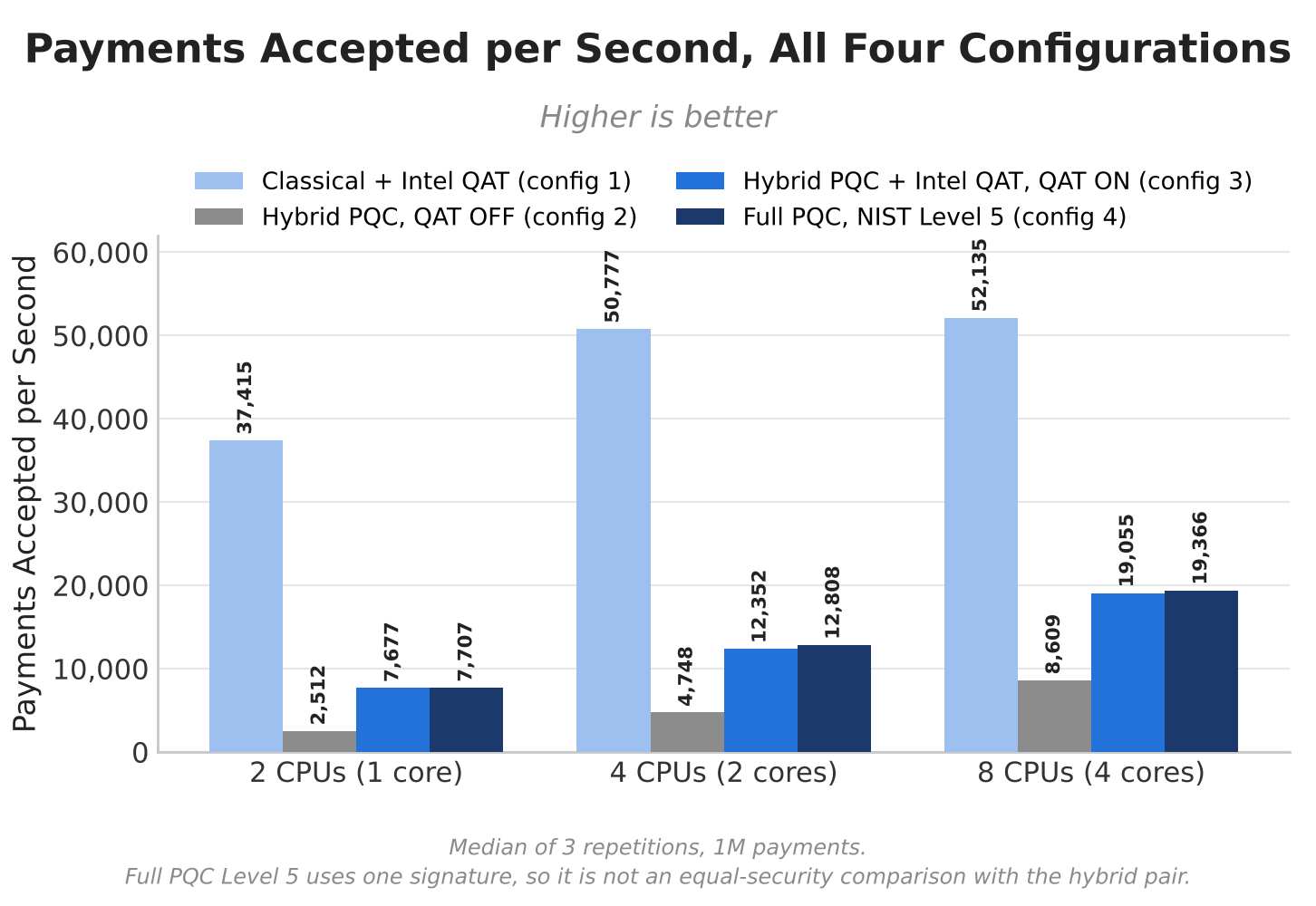
Figure 1 | Payments accepted per second for all four configurations by sender CPU count, one-million-payment batches.
The hybrid pair holds algorithms, CPUs and workload constant; the QAT runs add asynchronous offload, tuned per CPU count. Classical and full PQC are context; full PQC is NIST Level 5 with one signature, so it is not an equal-security comparison, yet hybrid with QAT runs within 4% of it at every measured point while signing twice per payment. The hybrid record pairs ML-DSA-65 (NIST category 3) with RSA-2048 (112-bit classical security) and is not an Internet Engineering Task Force (IETF) composite signature.
Solution Architecture
The benchmark implements an end-to-end batch payment pipeline that mirrors how treasury platforms and payment hubs release signed payment files to banks; the signing path is the variable under test. Each run signs 100,000 or 1,000,000 accounts-payable instructions at a concurrency of 128 on 2, 4 or 8 sender CPUs on socket 1. A sender CPU is one logical CPU, so 8 sender CPUs are 4 physical cores with hyperthreading enabled. Each configuration runs one warm-up and three measured repetitions, and reported values are medians.
Pipeline stages
- Stage 1: Signing. The sender signs every instruction with ML-DSA-65 and RSA-2048, plus one signature over the whole batch. With QAT active, the RSA operation runs on the QAT engines while ML-DSA stays on the Xeon cores.
- Stage 2: Packing. The signed batch is compressed with Zstandard (zstd) for transfer.
- Stage 3: Secure transfer. The batch crosses one mutual Transport Layer Security (TLS) 1.3 connection with the hybrid X25519MLKEM768 key exchange, so transport confidentiality is protected against harvest-now-decrypt-later. One handshake is opened per repetition; handshake rate was not measured.
- Stage 4: Verification and acknowledgement. The receiving bank verifies both signatures in software on 16 dedicated threads and returns a signed ISO 20022 pain.002 payment status report. The measurement window closes when that acknowledgement arrives.
QAT configuration
Parameter | Value |
QAT devices | 4 x integrated Intel QAT devices, 16 virtual functions each |
QAT software | QAT_Engine qatprovider v2.2.0, qatlib 26.02.0 |
Offloaded operation | RSA-2048 signing (RS256, PKCS#1 v1.5) |
Huge pages | 4,096 x 2 MB |
Table 3 | Intel QAT configuration.
Asynchronous request settings were tuned per CPU count, and the QAT OFF path makes no asynchronous QAT requests. A production deployment should alert if the QAT provider is not loaded or QAT utilization stays at zero, because the provider can fall back to software and still return a result.
Reference architecture
The following diagram describes the technical architecture. All components run on a single Dell PowerEdge R770 chassis. The measured window runs from the start of signing to the pain.002 acknowledgement; services drawn beside that path, including the agent and model hosts, were idle during measured runs.
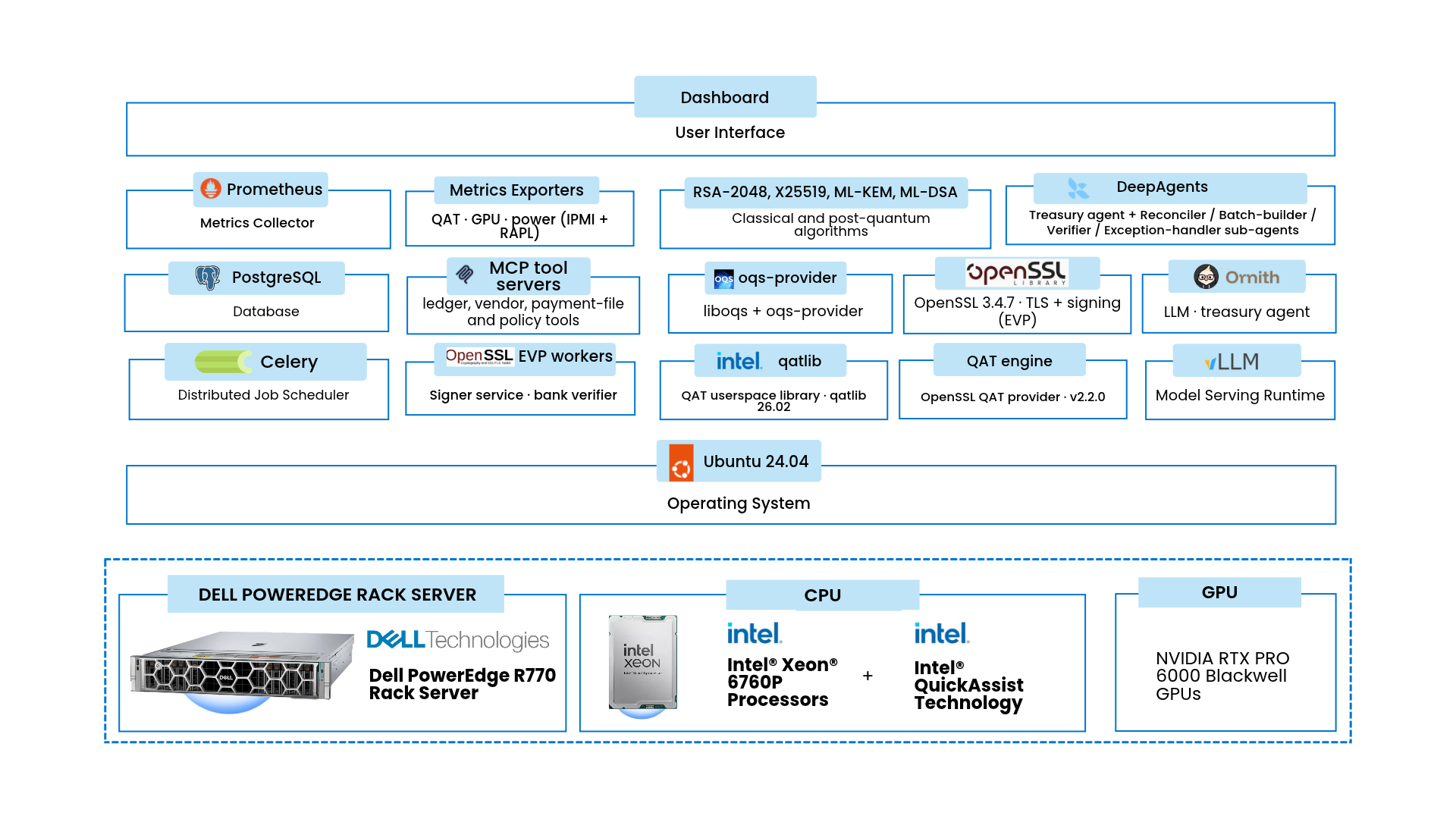
Figure 2 | Technical architecture of the hybrid payment signing workload on a single Dell PowerEdge R770.
Performance Benchmark
All results compare hybrid PQC with and without Intel QAT on the same chassis, using one-million-instruction batches and the median of three repetitions unless noted.
Throughput: More Quantum-Safe Payments per Signing CPU
QAT delivers 2.20x to 3.06x higher payment throughput than hybrid signing with QAT OFF in all six measured pairs. The gain is largest on the fewest sender CPUs, where signing dominates every available cycle, so each signing CPU releases more payments per second.
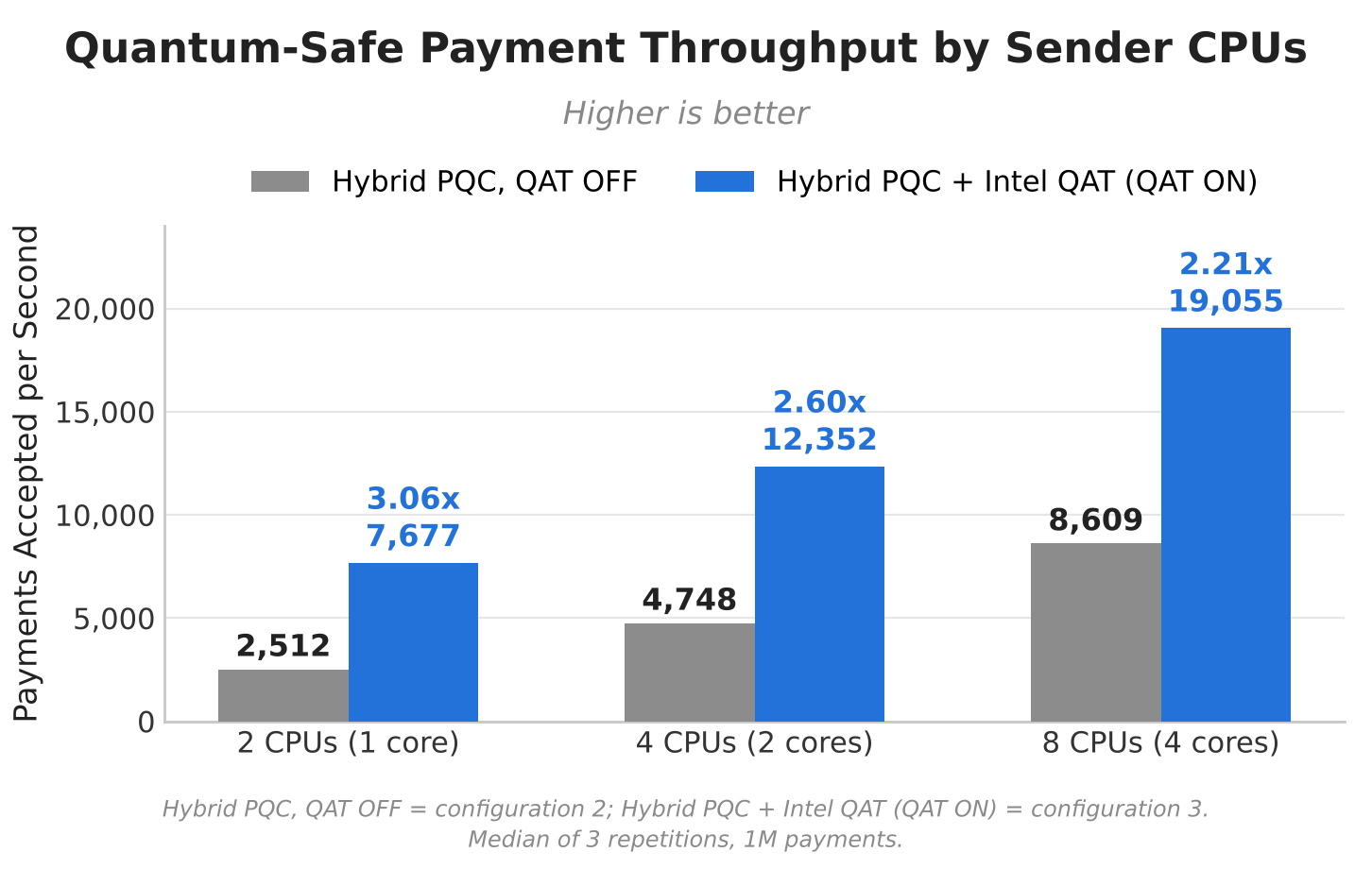
Figure 3 | Hybrid PQC payments accepted per second, QAT OFF and QAT ON, by sender CPU count.
Key takeaway: At eight sender CPUs, QAT lifts throughput from 8,609 to 19,055 payments per second. Four sender CPUs with QAT outperform eight sender CPUs without it by 43%. |
The ratio narrows as CPUs are added for two reasons. Packing, transfer, bank verification and acknowledgement take about 23 to 28 seconds per million payments, a path that carries more of the total as QAT shrinks signing. QAT-assisted signing also scales at about 88% efficiency from two to eight CPUs, against close to 100% with QAT OFF, so the signing-rate ratio itself falls from 3.61x to 3.20x. Batches of 100,000 instructions showed the same pattern at 3.00x, 2.55x and 2.20x.
Batch Time: Where the Seconds Go
With QAT, the R770 signs, sends and acknowledges one million payments in 52.5 seconds instead of 116.2 seconds on eight sender CPUs, and cuts batch time by up to 67.3% on two. Signing fell from 80% to 56% of the batch window.
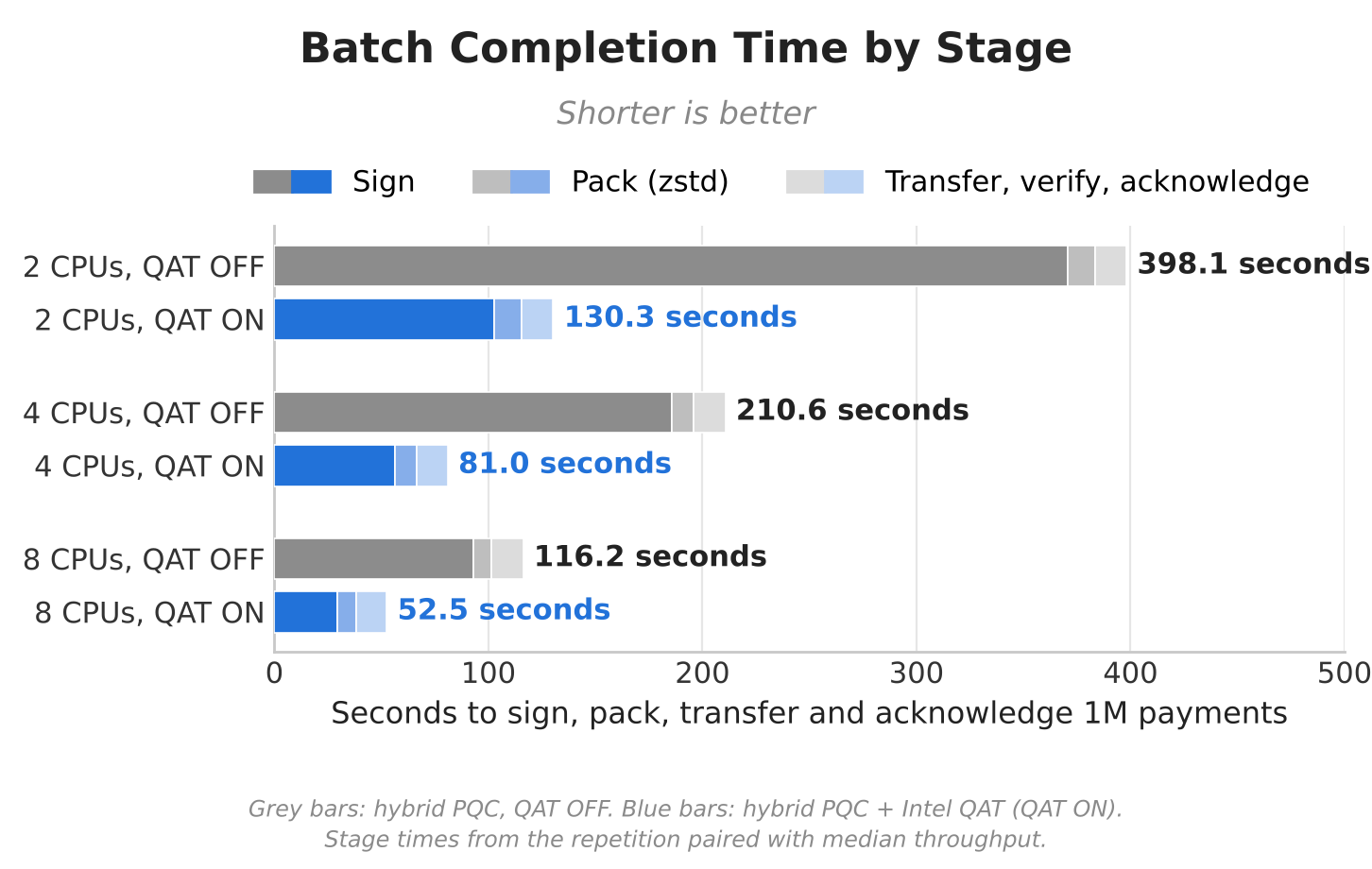
Figure 4 | Batch completion time by stage for one million payments, QAT OFF and QAT ON, by sender CPU count.
The signing rate rose 3.19x to 3.61x across runs, more than the end-to-end gain, because packing, transfer and verification are unchanged by QAT. At eight sender CPUs the remaining 23 seconds are packing (8.7 seconds), transfer (2.4 seconds), bank verification (5.7 to 5.8 seconds) and coordination including acknowledgement (6.4 to 6.5 seconds).
Energy Efficiency: Less Energy per Payment
Socket 1 CPU package energy above idle per payment falls at every sender CPU count when RSA signing moves to QAT engines.
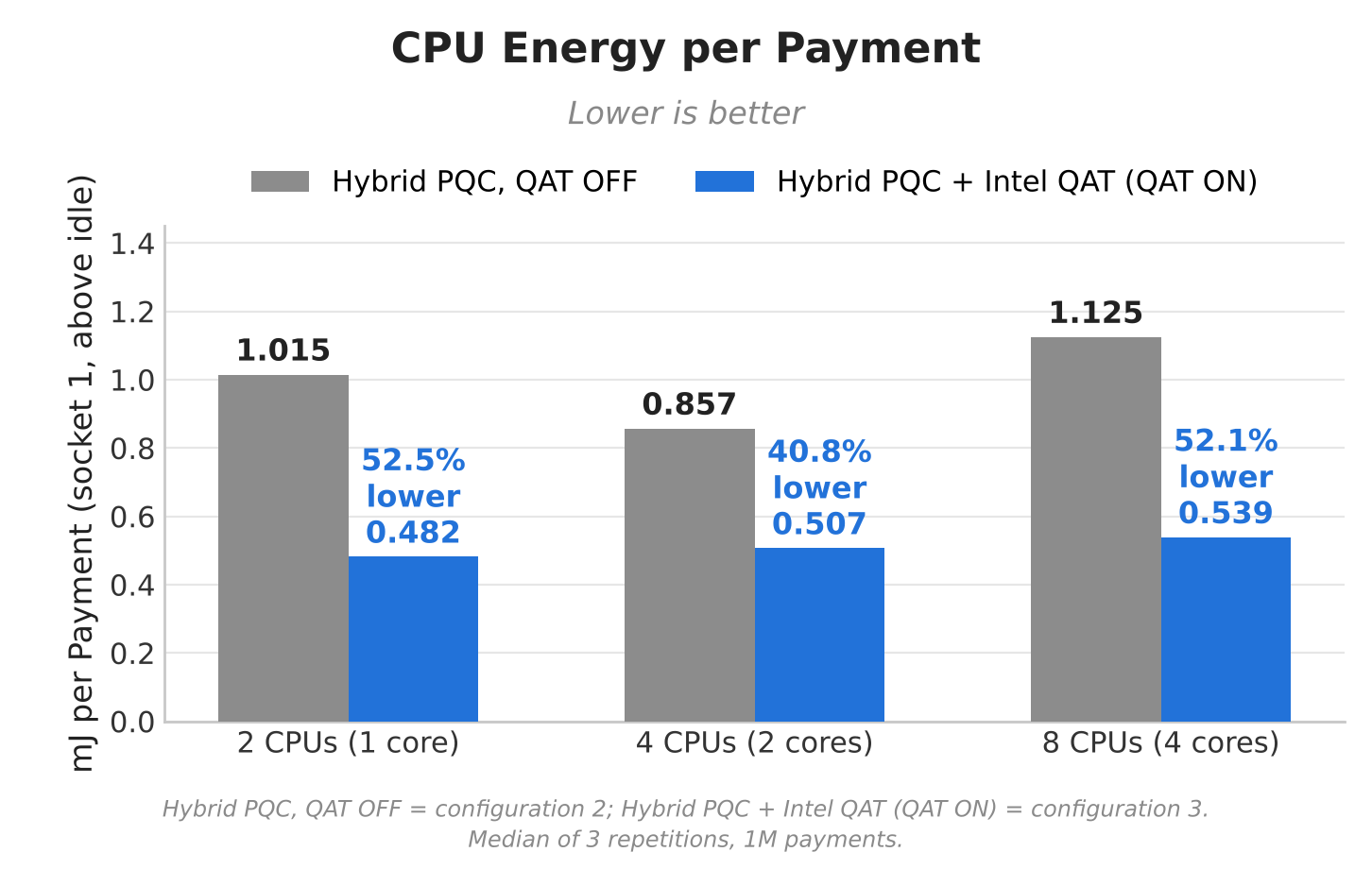
Figure 5 | CPU package energy above idle per payment, QAT OFF and QAT ON, by sender CPU count.
This measure covers the socket 1 package, which hosts the senders and the bank verifier, and excludes the two QAT devices on socket 0. A separate rerun that recorded both sockets found QAT adds about 1.9 watts on socket 0; across both sockets, energy per payment was 46% lower. The reduction is not monotonic because software hybrid energy per payment is lowest at four sender CPUs. Energy figures use the one-million-payment runs, which vary less than the 100,000-payment runs.
Key takeaway: Socket 1 CPU package energy per payment is lower with QAT, by 41% to 53% across the measured points. Do not read the 52% figure as a rack or chassis saving. Whole-node power rose by about 16 watts above idle in both configurations, so node energy per payment follows the 54.8% shorter batch. |
Payload and Verification: What QAT Does Not Change
Intel QAT changes compute time, not data size. Each hybrid payment packs to 3,620 bytes with or without QAT, 12.1 times the classical record, so a one-million-payment batch grows from 0.30 GB to 3.62 GB; a full PQC record at NIST Level 5 packs to 4,697 bytes. The measured transfer took 2.4 seconds on this chassis, but on a 1 Gbit/s path the same batch would need about 29 seconds, more than half of the 52.5-second QAT window.
Bank-side verification of both signatures took 5.7 to 5.8 seconds per million payments, well within the sender's pace, so verification did not limit throughput. Receiving institutions should still plan for it: hybrid signatures verify at about 40% of the classical rate, and the records are twelve times larger.
Consistency and Offload Evidence
Throughput in the hybrid pair showed a coefficient of variation of 0.29% or less, and the one-million-payment Hybrid + QAT result ranged from 18,836 to 19,055 payments per second across four test sessions on three separate days, a 1.2% spread. Every reported QAT run loaded the Intel QAT provider for OpenSSL; at eight sender CPUs the four QAT devices peaked at about 63% of their combined capacity, so they had headroom. All four QAT devices carried RSA load, including the two on socket 0, while every QAT OFF run stayed at zero.
Business Impact
The value of hybrid signing with QAT-offloaded RSA shows up in four places.
Do More Signing per Logical CPU
With 2.21x higher throughput at eight sender CPUs and up to 3.06x at two, a signing service on the Dell PowerEdge R770 meets the same payment volume with fewer logical CPUs. The gain narrows as signing CPUs are added, from 3.06x at two to 2.21x at eight; the measured matrix stops at eight sender CPUs.
Lower CPU Energy per Payment
Moving RSA signing to purpose-built QAT engines cut CPU package energy per payment by 41% to 53% on the measured socket, excluding socket-0 QAT power. Whole-node power above idle stayed near 16 watts in both configurations, so node energy per payment falls with the shorter batch.
Return Logical CPUs to Payment Services
Four logical sender CPUs (2 physical cores with hyperthreading enabled) with QAT outperformed eight logical sender CPUs without it by 43%. Teams can meet the same signing volume on fewer logical CPUs and assign the rest to payment validation, fraud screening or reconciliation on the same chassis.
Keep Settlement Windows on Schedule
A one-million-payment batch that took nearly two minutes with QAT OFF completed in 52.5 seconds with QAT. Treasury and payments teams that release files against settlement cut-off times gain back more than half of every batch window while adopting quantum-safe signatures.
What this means for platform decisions:
- For CTOs and IT directors: A measured path to quantum-safe payment signing ahead of the proposed 2030 RSA deprecation, with fewer signing CPUs for the same payment volume.
- For infrastructure architects: Platform configuration on QAT-enabled Xeon 6 SKUs (BIOS, IOMMU, VFIO, qatlib, huge pages and the QAT OpenSSL provider), plus a signer that keeps many RSA requests in flight, as this one did at a concurrency of 128. Plan network, storage and counterparty verification for records twelve times larger.
- For payments and treasury leaders: Hybrid PQC adoption without proportional growth in batch windows or added risk to settlement cut-offs.
Conclusion
Quantum-safe signing now sits on the critical path of every payment platform that must keep its records trustworthy beyond 2030. Getting the transition wrong means longer batch windows, cores spent on cryptography instead of payment services, and a rising energy bill.
Dell PowerEdge R770 with Intel Xeon 6 6760P and integrated Intel QAT addresses this challenge at the platform level. By offloading the RSA-2048 half of each hybrid signature to dedicated accelerators, the platform delivers 2.21x payment throughput at eight logical sender CPUs and up to 3.06x at two, cuts batch time by more than half and lowers CPU package energy per payment by 41% to 53% on the measured socket. On a QAT-enabled SKU the gain needs platform configuration and a signer that keeps many RSA requests in flight.
Appendix: Benchmark Methodology
Workload definition
The benchmark signs and transmits batches of payment instructions in an accounts-payable profile. Payments accepted per second equals the number of instructions in a batch divided by the window from the start of signing to the signed pain.002 acknowledgement. It counts complete signed payments, not TLS handshakes or individual signatures.
Isolation of the variable under test
Every variable that is not the cryptographic configuration is held constant across runs, including batch content, sender CPU pinning, concurrency, transport and bank verifier. All 24 measured test points (four configurations, three CPU counts, two batch sizes) passed validity checks, and background activity on the sender CPUs stayed under the 5% invalidation threshold.
Derived KPIs
Derived KPI | Formula | Business interpretation |
QAT acceleration multiplier | Payments per second (Hybrid + QAT) ÷ payments per second (Hybrid, QAT OFF) | Headline gain delivered by hardware offload |
Batch time reduction | (Window QAT OFF − window QAT ON) ÷ window QAT OFF | Batch window returned to the business |
Energy per payment reduction | (Energy per payment QAT OFF − energy per payment QAT ON) ÷ energy per payment QAT OFF | Socket 1 CPU package energy, not chassis energy |
Per-logical-CPU throughput | Payments per second ÷ logical sender CPUs | Signing output per assigned logical CPU |
Table 4 | Derived KPIs and their business interpretation.
Scope of results
Only the RSA leg is accelerated; ML-DSA signing, ML-KEM key exchange and bank verification run on CPU in every configuration. QAT accelerates the classical leg for as long as hybrid signing is in use; in a post-quantum-only deployment its role shifts to symmetric encryption and compression, which this study did not measure. The matrix stops at eight sender CPUs; no saturation point or cores-saved projection beyond the measured pairs is reported. Energy figures cover the socket 1 CPU package, not the whole system. Not tested: virtualized hosts, hardware security modules (signing keys were on the host), the OpenSSL FIPS provider, power-saving profiles, production network latency, a software multi-buffer RSA baseline, RSA-3072, an ECDSA classical half, and QAT restricted to the senders' own socket. The results assume a verifier that checks both signatures and a deployment that keeps the QAT provider loaded.
Appendix: System Under Test
Component | Specification |
Server platform | Dell PowerEdge R770 [9], BIOS 1.6.4 |
CPU | 2 x Intel Xeon 6 6760P [10], 64 cores each (128 cores / 256 threads), 4 NUMA nodes, microcode 0x1000405 |
Memory | 16 x 64 GB DDR5-6400 (1,007 GB visible) |
Accelerators | 4 x integrated Intel QAT devices, two per socket |
GPU | 2 x NVIDIA RTX PRO 6000 Blackwell Server Edition (not used for this workload) |
Operating system | Ubuntu 24.04.4 LTS, Linux kernel 6.8.0-146-generic, intel_iommu=on; performance governor, turbo on, C6 off |
Cryptography stack | OpenSSL 3.4.7 (default provider; FIPS provider not loaded), liboqs 0.16.0 (AVX-512VL Keccak [11]), oqs-provider 0.12.0-rc1 (release candidate) |
QAT software | QAT_Engine qatprovider v2.2.0, qatlib 26.02.0, loaded as the acceleration provider |
Payment signer | Custom payment signer, Rust 1.94.0. Each signature is a detached JWS; the batch signature covers the manifest, a newline and the SHA-256 of the packed bytes. mTLS uses TLS_AES_256_GCM_SHA384, rsa_pss_rsae_sha256 and a 2048-bit RSA client certificate |
Table 5 | System under test: hardware and software stack.
References
| 1. | NIST, FIPS 203, Module-Lattice-Based Key-Encapsulation Mechanism Standard, August 2024. https://csrc.nist.gov/pubs/fips/203/final |
| 2. | NIST, FIPS 204, Module-Lattice-Based Digital Signature Standard, August 2024. https://csrc.nist.gov/pubs/fips/204/final |
| 3. | NIST, IR 8547 (initial public draft), Transition to Post-Quantum Cryptography Standards, November 2024. https://csrc.nist.gov/pubs/ir/8547/ipd |
| 4. | ANSSI, ANSSI views on the Post-Quantum Cryptography transition (2023 follow up), December 2023. https://messervices.cyber.gouv.fr/documents-guides/follow_up_position_paper_on_post_quantum_cryptography.pdf |
| 5. | BSI, Technical Guideline TR-02102-1, Cryptographic Mechanisms: Recommendations and Key Lengths, Version 2026-01. https://www.bsi.bund.de/dok/TR-02102-en |
| 6. | Office of Management and Budget, M-26-15, Execution of the Migration to Post-Quantum Cryptography, June 2026. https://www.whitehouse.gov/wp-content/uploads/2026/06/M-26-15-Execution-of-the-Migration-to-Post-Quantum-Cryptography.pdf |
| 7. | Executive Order 14412, Securing the Nation Against Advanced Cryptographic Attacks, June 22, 2026, published June 25, 2026, 91 FR 38483, document 2026-12909. https://www.federalregister.gov/documents/2026/06/25/2026-12909/securing-the-nation-against-advanced-cryptographic-attacks |
| 8. | Intel, Accelerate Post-Quantum Cryptography with Intel Crypto Technologies, white paper 366990-001US, September 2025. https://www.intel.com/content/www/us/en/content-details/866282/accelerate-post-quantum-cryptography-with-intel-crypto-technologies.html |
| 9. | Dell Technologies, PowerEdge R770 Specification Sheet. https://www.delltechnologies.com/asset/en-us/products/servers/technical-support/poweredge-r770-spec-sheet.pdf |
| 10. | Intel, Intel Xeon 6760P Processor (320M Cache, 2.20 GHz) Specifications. https://www.intel.com/content/www/us/en/products/sku/241836/intel-xeon-6760p-processor-320m-cache-2-20-ghz/specifications.html |
| 11. | Intel, Post-Quantum Cryptography: Accelerating Open Quantum Safe Library with Intel AVX-512 Keccak 1600 Implementation, 367250-001US, October 2025. https://www.intel.com/content/www/us/en/content-details/868835/post-quantum-cryptography-accelerating-open-quantum-safe-library-with-intel-avx-512-keccak-1600-implementation.html |
Image sources: Dell Technologies and Intel product imagery; charts and architecture diagram created for this paper.
Copyright © 2026 Dell Inc. or its subsidiaries. All Rights Reserved. Testing was performed by a third party commissioned by Dell Technologies. Dell and other trademarks are trademarks of Dell Inc. or its subsidiaries. NVIDIA and RTX PRO are trademarks of NVIDIA Corporation. Intel, Xeon and QuickAssist are trademarks of Intel Corporation.
DISCLAIMER: Performance varies by hardware and software configurations, including testing conditions, system settings, application complexity, the quantity of data, batch sizes, software versions, libraries used, and other factors. The results of performance testing provided are intended for informational purposes only and should not be considered as a guarantee of actual performance.